MCQ
Assertion : Soft and hard $X-$ rays differ in frequency as well as velocity.
Reason : The penetrating power of hard $X-$ rays is more than the penetrating power of soft $X-$ rays.
  • A
    If both Assertion and Reason are correct and the Reason is a correct explanation of the Assertion.
  • B
    If both Assertion and Reason are correct but Reason is not a correct explanation of the Assertion.
  • C
    If the Assertion is correct but Reason is incorrect.
  • If both the Assertion and Reason are incorrect.
Answer

Correct option: D.
If both the Assertion and Reason are incorrect.
d
Soft and hard $X-$ rays differ only in frequency. Soft $X-$ rays have low frequency as compared to hard $X-$ rays. But both types of  $X-$ ray travel with speed of light.

Need a full question paper?

Generate a complete, print-ready paper with questions like this in minutes — across 16+ boards, with answer keys.

Start Generating Free

Similar questions

A charged capacitor discharges through a resistance $R$ with time constant $\tau$. The two are now placed in series across an $AC$ source of angular frequeny $\omega = \frac{1}{\tau }$ The impedance of the circuit will be-
This questions has statement$-1$ and statement$-2$. Of the four choices given after the statements, choose the one that best describe the two statements.
An insulating solid sphere of radius $R$ has a uniformly
positive charge density $\rho$. As a result of this uniform charge distribution there is a finite value of electric potential at the centre of the sphere, at the surface of the sphere and also at a point out side the sphere. The electric potential at infinite is zero.

Statement$ -1$ : When a charge $q$ is take from the centre of the surface of the sphere its potential energy changes by  $\frac{{q\rho }}{{3{\varepsilon _0}}}$

Statement$ -2$ : The electric field at a distance $r(r < R)$  from centre of the sphere is $\frac{{\rho r}}{{3{\varepsilon _0}}}$

An isolated rail car of mass $M$ is moving along a straight, frictionless track at an initial speed $v_0$. The car is passing under a bridge when $a$ crate filled with $N$ bowling balls, each of mass $m$, is dropped from the bridge into the bed of the rail car. The crate splits open and the bowling balls bounce around inside the rail car, but none of them fall out. What is the average speed of the rail car $+$ bowling balls system some time after the collision?
A neutron moving with velocity $u$ collides elastically with an atom of mass number $A$ . If the collision is head-on and the initial kinetic energy of neutron is $E$ , then the final kinetic energy of the neutron after collision is
The maximum wavelength of radiation emitted at $2000\;K$is $4\mu m$. What will be the maximum wavelength of radiation emitted at $2400\,K$ is ...... $\mu m$
A square loop is carrying a steady current $I$ and the magnitude of its magnetic dipole moment is $m$. If this square loop is changed to a circular loop and it carries the same current, the magnitude of the magnetic dipole moment of circular loop will be
The electric field intensity just sufficient to balance the earth's gravitational attraction on an electron will be: (given mass and charge of an electron respectively are $9.1 \times 10^{-31}\,kg$ and $1.6 \times$ $10^{-19}\,C$.)
An electric field of $1500\, V/m$ and a magnetic field of $0.40\, weber/metre^2$ act on  a moving electron. The minimum uniform speed along a straight line the electron could  have is
$100$ cells each of $e.m.f.$ $5\, V$ and internal resistance $1\, ohm$ are to be arranged so as to produce maximum current in a $25\, ohms$ resistance. Each row is to contain equal number of cells. The number of rows should be
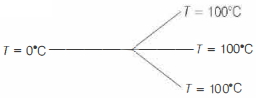
A metallic prong consists of $4$ rods made of the same material, cross-sections and same lengths as shown below. The three forked ends are kept at $100^{\circ} C$ and the handle end is at $0^{\circ} C$. The temperature of the junction is ............. $^{\circ} C$