$Assertion :$ Stress is the internal force per unitarea of a body.
$Reason :$ Rubber is more elastic than steel.
$Reason :$ Rubber is more elastic than steel.
AIIMS 2002, Easy


Download our appand get started for free
Experience the future of education. Simply download our apps or reach out to us for more information. Let's shape the future of learning together!No signup needed.*
Similar Questions
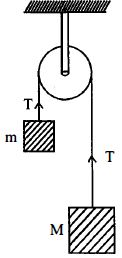
- 1Two blocks of masses $m$ and $M$ are connected by means of a metal wire of cross-sectional area $A$ passing over a frictionless fixed pulley as shown in the figure. The system is then released. If $M = 2\, m$, then the stress produced in the wire isView Solution
- 2View SolutionWhich of the following statements is correct
- 3A metal rod of cross-sectional area $10^{-4} \,m ^{2}$ is hanging in a chamber kept at $20^{\circ} C$ with a weight attached to its free end. The coefficient of thermal expansion of the rod is $2.5 \times 10^{-6} \,K ^{-1}$ and its Young's modulus is $4 \times 10^{12} \,N / m ^{2}$. When the temperature of the chamber is lowered to $T$, then a weight of $5000 \,N$ needs to be attached to the rod, so that its length is unchanged. Then, $T$ is ............ $^{\circ} C$View Solution
- 4How much force is required to produce an increase of $0.2\%$ in the length of a brass wire of diameter $0.6\, mm$ (Young’s modulus for brass = $0.9 \times {10^{11}}N/{m^2}$)View Solution
- 5Young's moduli of the material of wires $A$ and $B$ are in the ratio of $1: 4$, while its area of cross sections are in the ratio of $1: 3$. If the same amount of load is applied to both the wires, the amount of elongation produced in the wires $A$ and $B$ will be in the ratio ofView Solution
[Assume length of wires $A$ and $B$ are same]
- 6View SolutionMark the wrong statement
- 7View SolutionThe isothermal bulk modulus of a gas at atmospheric pressure is
- 8A metal wire of length $L_1$ and area of cross section $A$ is attached to a rigid support. Another metal wire of length $L_2$ and of the same cross sectional area is attached to the free end of the first wire. A body of mass $M$ is then suspended from the free end of the second wire. If $Y_1$ and $Y_2$ are the Youngs moduli of the wires respectively, the effective force constant of the system of two wires is :View Solution
- 9A stress of $1.5\,kg.wt/mm^2$ is applied to a wire of Young's modulus $5 \times 10^{11}\,N/m^2$ . The percentage increase in its length isView Solution
- 10View SolutionIf the length of a wire is reduced to half, then it can hold the ......... load