Question
Assertion  :   The coil is bound over the metallic frame in moving coil galvanometer.
Reason     : The metallic frame help in making steady deflection without any oscillation.(a) If both assertion and reason are true and the reason is the correct explanation of the assertion.(b) If both assertion and reason are true but reason is not the correct explanation of the assertion.(c) If assertion is true but reason is false.(d) If the assertion and reason both are false.


Answer

(a) If both assertion and reason are true and the reason is the correct explanation of the assertion.

Need a full question paper?

Generate a complete, print-ready paper with questions like this in minutes — across 16+ boards, with answer keys.

Start Generating Free

Similar questions

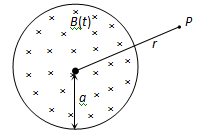
A uniform but time$-$varying magnetic field $B(t)$ exists in a circular region of radius $a$ and is directed into the plane of the paper, as shown. The magnitude of the induced electric field at point $P$ at a distance $r$ from the centre of the circular region
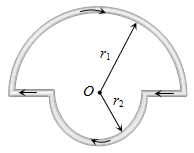
In the figure shown there are two semicircles of radii $r_1$ and $r_2$ in which a current $i$ is flowing. The magnetic induction  at the centre $O$ will be
Which of the following has zero average value in a plane electromagnetic wave?
Speed of electromagnetic waves in vacuum is:
If a magnet of length $10 \ cm$ and pole strength $40 \mathrm{A}-\mathrm{m}$ is placed at an angle of $45^{\circ} \mathrm{in}$ an uniform induction field of intensity $2 \times 10^{-4} \mathrm{T}$, the couple acting on it is
The charge density of a cone shaped object will be maximum:
The spectrum of light emitted by a glowing solid is(a) Continuous spectrum(b) Line spectrum(c) Band spectrum(d) Absorption spectrum
       
In a Young's double  slit experiment the source S and the two slits A and B are vertical with slit A above slit B. The fringes are observed on a vertical screen K. The optical path length from S to B is increased very slightly (by introducing a transparent material of higher refractive index) and the optical path length from S to A is not changed, as a result the fringe system on K moves(a) Vertically downwards slightly(b) Vertically upwards slightly(c) Horizontally, slightly to the left(d) Horizontally, slightly to the right
   
   
The line of force in a magnetic field represents the direction at each point that a magnetic needle placed at the point takes up. Do they also represent the direction of the force on a moving charge at each point?
An $a-$particle of $5\ MeV$ energy strikes with a nucleus of uranium at stationary at an scattering angle of $180^\circ$. The nearest distance upto which $a-$particle reaches the nucleus will be of the order of