Question
Assertion : The television broadcasting becomes weaker with increasing distance.
Reason    :  The power transmitted from TV transmitter varies inversely as the distance of the receiver(a) If both assertion and reason are true and the reason is the correct explanation of the assertion.(b) If both assertion and reason are true but reason is not the correct explanation of the assertion.(c) If assertion is true but reason is false.(d) If the assertion and reason both are false.


Answer

(c) If assertion is true but reason is false.

Need a full question paper?

Generate a complete, print-ready paper with questions like this in minutes — across 16+ boards, with answer keys.

Start Generating Free

Similar questions

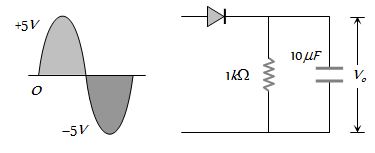
The output in the circuit of figure is taken across a capacitor. It is as shown in figure
Two electric bulbs whose resistances are in the ratio of 1 : 2 are connected in parallel to a constant voltage source. The powers dissipated in them have the ratio(a) 1 : 2(b) 1 : 1(c) 2 : 1(d) 1 : 4
       
In meter bridge or Wheatstone bridge for measurement of resistance, the known and the unknown resistance are interchanged. The error so removed is:
The shortest wavelength in the Lyman series of hydrogen spectrum is 912 Å corresponding to a photon energy of 13.6 eV. The shortest wavelength in the Balmer series is about(a) 3648 Å(b) 8208 Å(c) 1228 Å(d) 6566 Å
       
The ratio of radii of nuclei $13^{\mathrm{Al}^{27}}$ and $52^{\mathrm{X}^{\mathrm{A}}}$ is $3: 5$.The number of neutrons in the nuclei of $X$ will be
When does a magnetic dipole possess maximum potential energy inside a magnetic field?
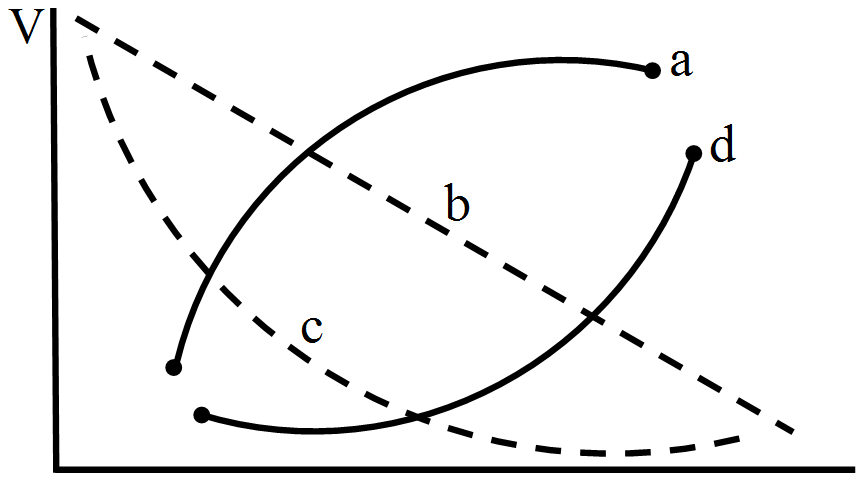
Which of the following curves may represent the speed of the electron in a hydrogen atom as a function of the principal quantum number n?
Assertion  :   The tyres of aircraft's are slightly conducting.
Reason      : If a conductor is connected to ground, the extra charge induced on conductor will flow to ground.(a) If both assertion and reason are true and the reason is the correct explanation of the assertion.(b) If both assertion and reason are true but reason is not the correct explanation of the assertion.(c) If assertion is true but reason is false.(d) If the assertion and reason both are false.


An electron falls from rest through a vertical distance h in a uniform and vertically upward directed electric field E. The direction of electric field is now reversed, keeping its magnitude the same. A proton is allowed to fall from rest in it through the same vertical distance h. The time of fall of the electron, in comparison to the time of fall of the proton is:
A beam of monochromatic blue light of wavelength 4200Å in air travels in water (μ = 4/3). Its wavelength in water will be(a) 2800 Å (b) 5600 Å (c) 3150 Å(d) 4000 Å