MCQ
Assertion: To convert a galvanometer into an ammeter a small resistance is connected in parallel with it.

Reason: The small resistance increases the combined resistance of the combination.

  • A
    If both Assertion and Reason are correct and Reason is the correct explanation of Assertion.
  • B
    If both Assertion and Reason are correct, but Reason is not the correct explanation of Assertion.
  • If Assertion is correct but Reason is incorrect.
  • D
    If both the Assertion and Reason are incorrect.
Answer

Correct option: C.
If Assertion is correct but Reason is incorrect.
c
An ammeter should have a low resistance which we get when we connect low resistance in parallel with galvanometer.

Need a full question paper?

Generate a complete, print-ready paper with questions like this in minutes — across 16+ boards, with answer keys.

Start Generating Free

Similar questions

A soap bubble, having radius of $1\; \mathrm{mm}$, is blown from a detergent solution having a surface tension of $2.5 \times 10^{-2}\; N / m$. The pressure inside the bubble equals at a point $Z_{0}$ below the free surface of water in a container. Taking $g=10\; \mathrm{m} / \mathrm{s}^{2}$ density of water $=10^{3} \;\mathrm{kg} / \mathrm{m}^{3},$ the value of $\mathrm{Z}_{0}$ is......$cm$
The current in the windings of a toroid is $2.0\,A$. There are $400\,turns$ and the mean circumferential length is $40\,cm$. If the inside magnetic field is $1.0\,T,$ the relative permeability is near to
When a $_4B{e^9}$ atom is bombarded with $\alpha - $ particles, one of the product of nuclear transmutation is $_6{C^{12}}$. The other is
The $r.m.s.$ velocity will be greater for
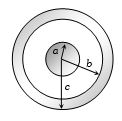
A solid conducting sphere of radius $a$ has a net positive charge $2Q$. A conducting spherical shell of inner radius $b$ and outer radius $c$ is concentric with the solid sphere and has a net charge $-Q$. The surface charge density on the inner and outer surfaces of the spherical shell will be
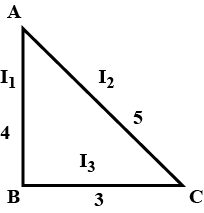
For the adjoining diagram, the incorrect relation between $I_{1}, I_{2}$ and $I_{3}$ is ($I-$ moment of inertia)
A copper rod of cross-sectional area $A$ carries a uniform current $I$ through it. At temperature $T$, if the volume charge density of the rod is $\rho $, how long will the charges take to travel a distance $d$ ?
The unit of Planck's constant is
A parallel plate capacitor has an electric field of ${10^5}\,V/m$ between the plates. If the charge on the capacitor plate is $1\,\mu \,C$, the force on each capacitor plate is......$N$
A parallel plate capacitor is charged to a potential difference of $50\, V$. It is discharged through a resistance. After $1$ second, the potential difference between plates becomes $40 \,V$. Then