Question
Assertion  :  Two P-N junction diodes placed back to back, will work as a NPN transistor.
Reason     : The P-region of two PN junction diodes back to back will form the base of NPN transistor.(a) If both assertion and reason are true and the reason is the correct explanation of the assertion.(b) If both assertion and reason are true but reason is not the correct explanation of the assertion.(c) If assertion is true but reason is false.(d) If the assertion and reason both are false.


Answer

(d) If the assertion and reason both are false.
Need a full question paper?

Generate a complete, print-ready paper with questions like this in minutes — across 16+ boards, with answer keys.

Start Generating Free

Similar questions

The electric potential at the centre of a charged spherical conductor in comparison with the potential at the surface of the conductor:
In an adiabatic process on a gas with $\gamma=1.4,$ the pressure is increased by 0.5%. The volume decreases by about:
  1. 0.36%
  2. 0.5%
  3. 0.7%
  4. 1%​​
A student says that he had applied a force $\text{F}=-\text{k}\sqrt{\text{x}}$ on a particle and the particle moved in simple harmonic motion. He refuses to tell whether k is a constant or not. Assume that he was worked only with positive x and no other force acted on the particle.
  1. As x increases k increases.
  2. As x increases k decreases.
  3. As x increases k remains constant.
  4. The motion cannot be simple harmonic.
Ultraviolet radiations of $6.2 \ eV$ falls on an aluminium surface $($work function $4.2 \ eV ).$ The kinetic energy in joules of the fastest electron emitted is approximately
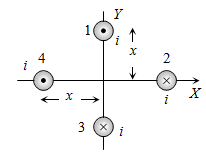
What will be the resultant magnetic field at origin due to four infinite length wires. If each wire produces magnetic field $'B\ '$ at origin
An organ pipe, open at both ends, contains
  1. Longitudinal stationary waves.
  2. Longitudinal travelling waves.
  3. Transverse stationary waves.
  4. Transverse travelling waves.
Two small balls having the same mass and charge and located on the same vertical at heights $h_1$ and $h_2$ are thrown in the same direction along the horizontal at the same velocity $v.$ The first ball touches the ground at a distance l from the initial vertical. At what height $H_2$ will the second ball be at this instant ? The air drag and the effect of the charges induced on the ground should be neglected.
The plate current in a diode is zero. It is possible that:
  1. The plate voltage is zero.
  2. The plate voltage is slightly negative.
  3. The plate voltage is slightly positive.
  4. The temperature of the filament is low.
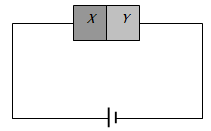
A semiconductor $X$ is made by doping a germanium crystal with arsenic $(Z = 33).$ A second semiconductor $Y$ is made by doping germanium with indium $(Z = 49).$ The two are joined end to end and connected to a battery as shown. Which of the following statements is correct
L, C and R represent physical quantities-inductance, capacitance and resistance respectively. The one which has same dimensions as time is: