MCQ
$Assertion :$ Two waves moving in a uniform string having uniform tension cannot have different velocities.
$Reason :$ Elastic and inertial properties of string are same for all waves in same string. Moreover speed of wave in a string depends on its elastic and inertial properties only.
  • A
    If both Assertion and Reason are correct and the Reason is a correct explanation of the Assertion.
  • B
    If both Assertion and Reason are correct but Reason is not a correct explanation of the Assertion.
  • C
    If the Assertion is correct but Reason is incorrect.
  • If both the Assertion and Reason are incorrect.
Answer

Correct option: D.
If both the Assertion and Reason are incorrect.
d
Two waves moving in uniform string with uniform tension shall have same speed and may be moving in opposite directions. Hence both waves may have velocities in opposite direction. Hence Assertion is incorrect.

Need a full question paper?

Generate a complete, print-ready paper with questions like this in minutes — across 16+ boards, with answer keys.

Start Generating Free

Similar questions

A body of mass $m$ moving with velocity $v$ makes a head on perfectly inelastic collision with another body of mass $2\,m$ which is initially at rest. Then percentage loss in the kinetic energy 
The equation of a wave on a string of linear mass density $0.04\, kgm^{-1}$ is given by : $y = 0.02\,\left( m \right)\,\sin \,\left[ {2\pi \left( {\frac{t}{{0.04\left( s \right)}} - \frac{x}{{0.50\left( m \right)}}} \right)} \right]$. The tension in the string is ..... $N$
If a black body is heated at a high temperature, it seems to be
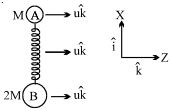
Two masses $A$ and $B$ of mass $M$ and $2M$ respectively are connected by a compressed ideal spring. The system is placed on $a$ horizontal frictionless table and given $a$ velocity $u\, \hat k$ in the $z$ -direction as shown in the figure. The spring is then released. In the subsequent motion the line from $B$ to $A$ always points along the $\hat i$ unit vector. At some instant of $\rho$ time mass $B$ has $a$ $x$ -component of velocity as $V_x\, \hat i$ . The velocity ${\vec V_A}$ of as $A$ at that instant is
A body of mass $(4m)$ is lying in $x-y$ plane at rest. It suddenly explodes into three pieces. Two pieces, each of mass $(m)$ move perpendicular to each other with equal speeds $(v).$ The total kinetic energy generated due to explosion is................. $mv^2$
Consider the following two statements:
$A.$ Linear momentum of the system remains constant.
$B.$ Centre of mass of the system remains at rest.
Quantity $Z$ varies with $x$ and $y$ , according to given equation $Z = x^2y - xy^2$ , where $x = 3.0 \pm 0.1$ and $y = 2.0 \pm 0.1$ . The value of $Z$ is 
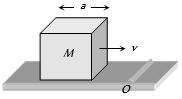
A cubical block of side $a$ is moving with velocity $v$ on a horizontal smooth plane as shown. It hits a ridge at point $O$. The angular speed of the block after it hits $O$ is 
Given below are two statements :

$Statement$ $(I)$ :Viscosity of gases is greater than that of liquids.

$Statement$ $(II)$ : Surface tension of a liquid decreases due to the presence of insoluble impurities.

In the light of the above statements, choose the most appropriate answer from the options given below :

Two wires of the same material have lengths in the ratio 1 : 2 and their radii are in the ratio $1:\sqrt 2 $. If they are stretched by applying equal forces, the increase in their lengths will be in the ratio