MCQ
$Assertion$ : Velocity-time graph for an object in uniform motion along a straight path is a straight line parallel to the time axis.

$Reason$ : In uniform motion of an object velocity increases as the square of time elapsed.

  • A
    If both Assertion and Reason are correct and the Reason is a correct explanation of the Assertion.
  • B
    If both Assertion and Reason are correct but Reason is not a correct explanation of the Assertion.
  • If the Assertion is correct but Reason is incorrect.
  • D
    If both the Assertion and Reason are incorrect.
Answer

Correct option: C.
If the Assertion is correct but Reason is incorrect.
c
In uniform motion the object moves with uniform velocity, the magnitude of its velocity at different instance i.e., at $t = 0, t =1, sec, t = 2\,sec .....$ will always be constant. Thus velocity-time graph for an object in uniform motion along a straight path is a straight line parallel to time axis.

Need a full question paper?

Generate a complete, print-ready paper with questions like this in minutes — across 16+ boards, with answer keys.

Start Generating Free

Similar questions

If you set up the ninth harmonic on a string fixed at both ends, its frequency compared to the seventh harmonic
To make the frequency double of a spring oscillator, we have to
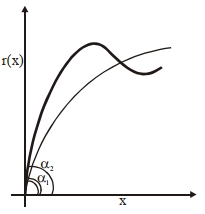
A projectile is launched from the origin in the $xy$ plane ( $x$ is the horizontal and $y$ is the vertically up direction) making an angle $\alpha$ from the $x$-axis. If its distance. $r =\sqrt{ x ^2+ y ^2}$ from the origin is plotted against $x$, the resulting curves show different behaviours for launch angles $\alpha_1$ and $\alpha_2$ as shown in the figure below. For $\alpha_1, r ( x )$ keeps increasing with $x$ while for $\alpha_2$, $r(x)$ increases and reaches a maximum, then decreases and goes through a minimum before increasing again. The switch between these two cases takes place at an angle $\alpha_c\left(\alpha_1 < \alpha_c < \alpha_2\right)$. The value of $\alpha_c$ is [ignore where $v_0$ is the initial speed of the projectile and $g$ is the acceleration due to gravity]
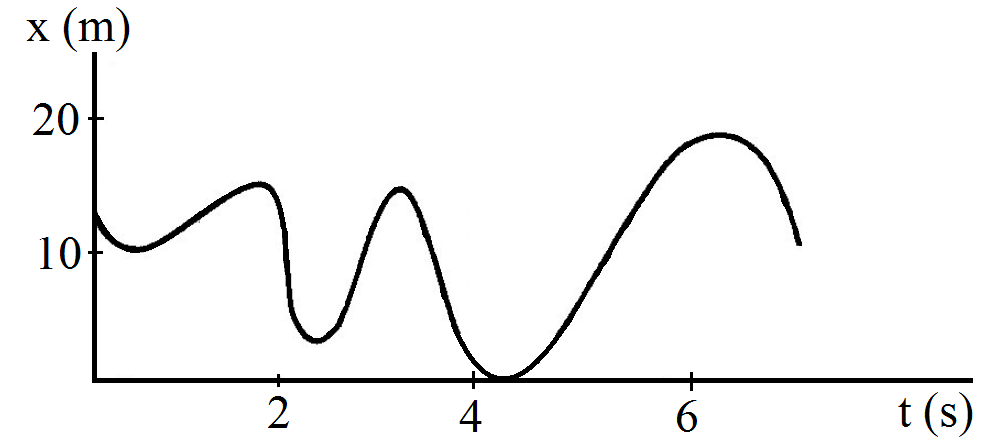
Figure shows the position of a particle moving on the $X-$axis as a function of time.
An object is dropped from a height $h$ from the ground. Every time it hits the ground it looses $50\%$ of its kinetic energy. The total distance covered as $t \to \infty $ is
A positive point charge Q is brought near an isolated metal cube.
A projectile is fired vertically upwards with an initial velocity $u$. After an interval of $T$ seconds a second projectile is fired vertically upwards, also with initial velocity $u$.
A solid cylinder of mass $3\, kg$ is rolling on a horizontal surface with velocity $4\, m s^{- 1}$. It collides with a horizontal spring of force constant $200 \,N m^{-1}$. The maximum compression produced in the spring will be ............... $\mathrm{m}$
A particle executes simple harmonic oscillation with an amplitude $a.$ The period of oscillation is $T.$ The minimum time taken by the particle to travel half of the amplitude from the equilibrium position is 
A sphere of mass $m $ moving with a constant velocity $u$ hits another stationary sphere of the same mass. If $e$  is the coefficient of restitution, then the ratio of the velocity of two spheres after collision will be