Question
Assertion : When ultraviolet light is incident on a photocell, its stopping potential is $V_0$ and the maximum kinetic energy of the photoelectrons is $K_{max}$ .When the ultraviolet light is replaced by $X-$ rays, both $V_0$ and $K_{max}$ increase.
Reason : Photoelectrons are emitted with speeds ranging from zero to a maximum value because of the range of frequencies present in the incident light.
Answer

We know that $eV_0 = K_{max} = hv -\phi $ where, $\phi $ is the work function . Hence, as $v$ increases (note that frequency of $X-$ rays is greater than that of $U.V.$ rays), both $V_0$ and $K_{max}$ increase. So assertion is correct.

Need a full question paper?

Generate a complete, print-ready paper with questions like this in minutes — across 16+ boards, with answer keys.

Start Generating Free

Similar questions

Consider the following statements

Assertion $(A)$ : $A$ cyclist always bends inwards while negotiating a curve

Reason $(R)$ : By bending he lowers his centre of gravity Of these statements,

If the units of force, energy and velocity are respectively $10\, N, 100\, J, 5\, m/s$, then  the units of length, mass and time will be
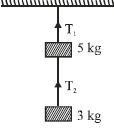
Two masses of $5\, kg$ and $3\, kg$ are suspended with the help of massless inextensible strings as shown in figure. The whole system is going upwards with an acceleration of $2\, ms^{-2}$. The tensions $T_1$ and $T_2$ are respectively (Take $g = 10\, ms^{-2}$)
Two vibrating tuning forks produce progressive waves given by $y_1= 4 \sin (500 \, \pi t)$  and $y_2= 2 \sin (506 \, \pi t)$. These tuning forks are held near the ear of a person.  The person will hear
For a particular resonance tube, following are four of the six harmonics below $1000 Hz$; $300,600,750$ and $900 \,Hz$. The two missing harmonics are
If the current is doubled, the deflection is also doubled in
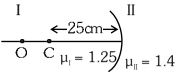
Region $I$ and $II$ are separated by a spherical surface of radius $25\, {cm}$. An object is kept in region $I$ at a distance of $40\, {cm}$ from the surface. The distance of the image from the surface is $.....\,cm$
A man is $180\,cm$ tall and his eyes are $10\,cm$ below the top of his head. In order to see his entire height right from toe to head, he uses a plane mirror kept at a distance of $1m$ from him. The minimum length of the plane mirror required is.....$cm$
A particle of unit mass undergoes one­ dimensional motion such that its velocity varies according to $ v(x)= \beta {x^{ - 2n}}$, where $\beta$ and $n$ are constants and $x$ is the position of the particle. The acceleration of the particle as a function of $x$, is given by
Kinetic energy of emitted cathode rays is dependent on