MCQ
Associated to a random experiment two events A and B are such that $\text{P(B)}=\frac{3}{5},\text{P}(\text{A}|\text{B})=\frac{1}{2}$ and $\text{P}(\text{A}\cup\text{B})=\frac{4}{5}$. The value pf P(A) is
  • A
    $\frac{3}{10}$
  • B
    $\frac{1}{2}$
  • C
    $\frac{1}{10}$
  • D
    $\frac{3}{5}$

Answer

  1. $\frac{1}{2}$

Solution:

$\text{P(B)}=\frac{3}{5},\text{P}\Big(\frac{\text{A}}{\text{B}}\Big)=\frac{1}{2},\text{P}(\text{A}\cup\text{B})=\frac{4}{5}$

$\text{P}\Big(\frac{\text{A}}{\text{B}}\Big)=\frac{1}{2}$

$\frac{\text{P}(\text{A}\cap\text{B})}{\text{P(B)}}=\frac{1}{2}$

$\frac{\text{P}(\text{A}\cap\text{B})}{\frac{3}{5}}=\frac{1}{2}$

$\text{P}(\text{A}\cap\text{B})=\frac{3}{10}$

$\text{P(A)}+\text{P(B)}-\text{P}(\text{A}\cup\text{B})=\frac{3}{10}$

$\text{P(A)}+\frac{3}{5}-\frac{4}{5}=\frac{3}{10}$

$\text{P(A)}=\frac{1}{2}$

Need a full question paper?

Generate a complete, print-ready paper with questions like this in minutes — across 16+ boards, with answer keys.

Start Generating Free

Similar questions

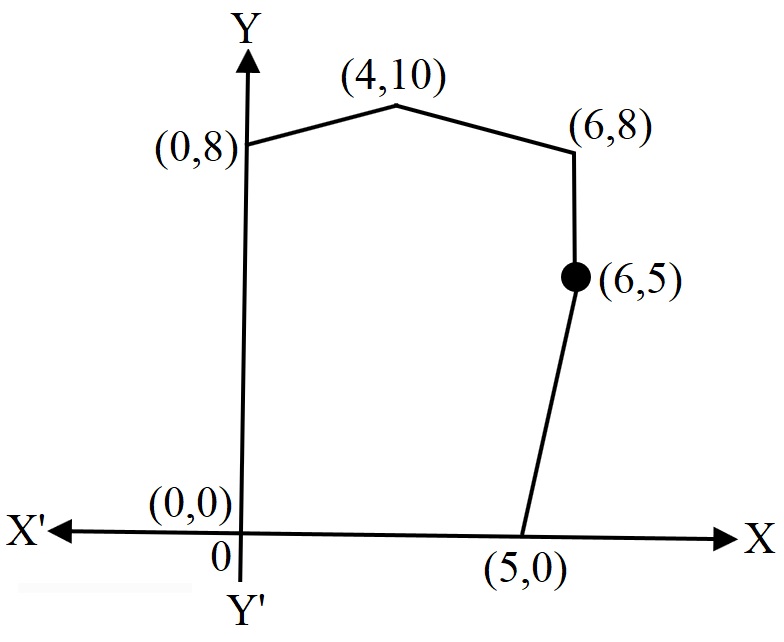
The feasible solution for a LPP is shown in the following figure. Let Z = 3x - 4y be the objective function.

Minimum of Z occurs at:

Choose the correct answer from the given four options.
Distance of the point $(\alpha,\beta,\gamma)$ from y-axis is:
If $y$ = $|cos 4x| + |sin 4x| + |tan 4x|$ then $\frac{{dy}}{{dx}}$ at $x = \frac{\pi }{6}$ is
Let $\vec{a}=\hat{i}+2 \hat{j}+3 \hat{k}$ and $\vec{b}=\hat{i}+\hat{j}-\hat{k}$. If $\vec{c}$ is a vector such that $\vec{a} \cdot \vec{c}=11, \vec{b} \cdot(\vec{a} \times \vec{c})=27$ and $\vec{b} \cdot \vec{c}=-\sqrt{3}|\vec{b}|$, then $|\vec{a} \times \vec{c}|^2$ is equal to
If the points $A(9,\,\,8,\, - 10)$, $B(3,\,\,2,\,\, - 4)$ and $C(5,\,\,4,\, - 6)$ be collinear, then the point $C$ divides the line $AB$ in the ratio
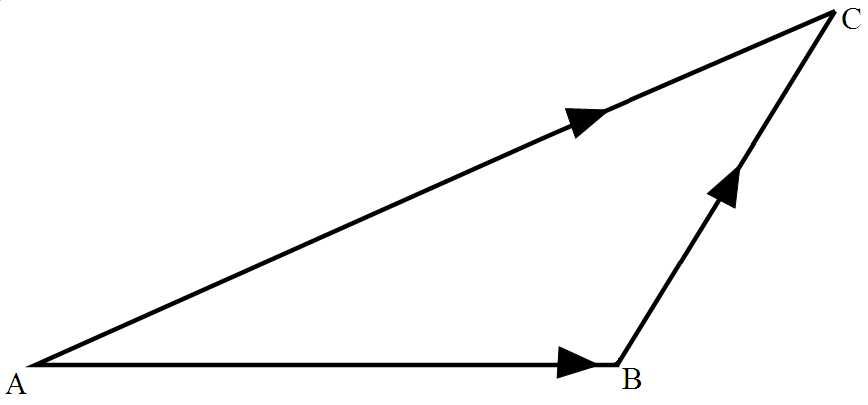
In figure, which of the following is not true?

  1. $​​​​​\overrightarrow{\text{AB}}+\overrightarrow{\text{BC}}+\overrightarrow{\text{CA}}=\vec0$

  2. $​​​​​\overrightarrow{\text{AB}}+\overrightarrow{\text{BC}}-\overrightarrow{\text{AC}}=\vec0$

  3. $​​​​​\overrightarrow{\text{AB}}+\overrightarrow{\text{BC}}-\overrightarrow{\text{CA}}=\vec0$

  4. $​​​​​\overrightarrow{\text{AB}}-\overrightarrow{\text{CB}}+\overrightarrow{\text{CA}}=\vec0$

If $\quad A=\left[\begin{array}{cc}\cos \theta & \text { isin } \theta \\ \operatorname{isin} \theta & \cos \theta\end{array}\right], \left(\theta=\frac{\pi}{24}\right)$ and $A^{5}=\left[\begin{array}{ll}a & b \\ c & d\end{array}\right],$ where $i=\sqrt{-1},$ then which one of the following is not true?
Let $f(x)=7 \tan ^8 x+7 \tan ^6 x-3 \tan ^4 x-3 \tan ^2 x$ for all $x \in\left(-\frac{\pi}{2}, \frac{\pi}{2}\right)$. Then the correct expression$(s)$ is(are)

$(A)$ $\int^{\pi / 4} x f(x) d x=\frac{1}{12}$

$(B)$ $\int_0^{\pi / 4} f(x) d x=0$

$(C)$ $\int_0^{\pi / 4} x f(x) d x=\frac{1}{6}$

$(D)$ $\int_0^{\pi / 4} f(x) d x=1$

Let A and B be two events such that P(A) = 0.6, P(B) = 0.2, P(A|B) = 0.5. Then $\text{P}(\overline{\text{A}}|\overline{\text{B}})$ equals.
  1. $\frac{1}{10}$
  2. $\frac{3}{10}$
  3. $\frac{3}{8}$
  4. $\frac{6}{7}$
Total number of possible matrices of order $3 \times 3$ with each entry 2 or 0 is