MCQ
Assume that a drop of liquid evaporates by decrease in its surface energy, so that its temperature remains unchanged. What should be the minimum radius of the drop for this to be possible? The surface tension is $T$, density of liquid is $\rho$ and $L$ is its latent heat of vaporization.
  • A
    $\frac{{\rho L}}{T}$
  • B
    $\sqrt {\frac{T}{{\rho L}}} $
  • C
    $\frac{T}{{\rho L}}$
  • $\frac{2T}{{\rho L}}$

Answer

Correct option: D.
$\frac{2T}{{\rho L}}$
d
Energy for vaporization $=$ change in surface energy $\rho\left(4 \pi r^{2} \mathrm{d} r\right) L=T(8 \pi \mathbf{r d r})$

$\Rightarrow r=\frac{2 \mathrm{T}}{\rho \mathrm{L}}$

Need a full question paper?

Generate a complete, print-ready paper with questions like this in minutes — across 16+ boards, with answer keys.

Start Generating Free

Similar questions

A sample of radioactive element containing $4 \times 10^{16}$ active nuclei. Half life of element is $10$ days, then number of decayed nuclei after $30$ days is  ........ $\times 10^{16}$ 
When kinetic energy of a body becomes $36$ times of its original value, the percentage increase in the momentum of the body will be :
A massless inextensible string in the form of a loop is placed on a horizontal film of soap solution of surface tension $T$. If film is pierced inside the loop and it convert into a circular loop of diameter $d$, then the tension produced in string is ..........
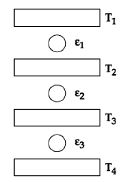
Three Carnot engines operate in series between a heat source at a temperature $T_1$ and a heat sink at temperature $T_4$ (see figure). There are two other reservoirs at temperature $T_2$ and $T_3$, as shown, with $T_1 > T_2 > T_3 > T_4$. The three engines are equally efficient if
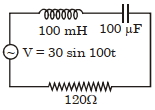
Find the peak current and reZsonant frequency of the following circuit (as shown in figure).
A Carnot engine absorbs $1000\,J$ of heat energy from a reservoir at $127\,^oC$ and rejects $600\,J$ of heat energy during each cycle. The efficiency of engine and temperature of sink will be
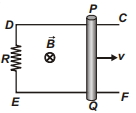
A frame $C D E F$ is placed in a region where a magnetic field $\vec{B}$ is present. A rod of length one metre moves with constant velocity $20 \,m / s$ and strength of magnetic field is one tesla. The power spent in the process is .............. $kW$ (take $R=$ $0.2 \,\Omega$ and all other wires and rod have zero resistance)
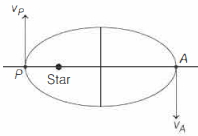
A planet orbits in an elliptical path of eccentricity $e$ around a massive star considered fixed at one of the foci. The point in space, where it is closest to the star is denoted by $P$ and the point, where it is farthest is denoted by $A$. Let $v_P$ and $v_A$ be the respective speeds at $P$ and $A$, then
A moving coil galvanometer has a resistance of $50\,\Omega $ and gives full scale deflection for $10\, mA$. How could it be converted into an ammeter with a full scale deflection for $1\,A$
Two resistors are joined in parallel whose, resultant is $\frac{6}{5} \,\Omega$. One of the resistance wire is broken and the effective resistance becomes $2 \,ohms$. Then the resistance (in $ohm$) of the wire that got broken is ..........