MCQ
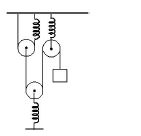
Assuming all pulleys, springs and string massless. Consider all surface smooth. Choose the correct statement $(s)$
  • A
    The angular frequency for small oscillation of the system is $\sqrt \frac{K}{3m}$
  • The angular frequency for small oscillation of the system is $\sqrt \frac{4K}{33m}$
  • C
    The elastic potential energy of system at equilibrium is $\frac{33m^2g^2}{4K}$
  • D
    The elastic potential energy of system at equilibrium is $\frac{3m^2g^2}{2K}$

Answer

Correct option: B.
The angular frequency for small oscillation of the system is $\sqrt \frac{4K}{33m}$
b
$x=\frac{y_{1}}{2}+2 y_{2}+2 y_{3}$       $...(1)$

$\Delta \mathrm{T}=\mathrm{ma}$       $...(2)$

$2 \Delta \mathrm{T}=\mathrm{Ky}_{2}$           $...(3)$

$2 \Delta \mathrm{T}=\mathrm{Ky}_{3}$           $...(4)$

$\frac{\Delta \mathrm{T}}{2}=\mathrm{Ky}_{1}$           $...(5)$

Solving eqn.

$x=\Delta T\left(\frac{33}{4 K}\right)$

$w^{2}=\left(\frac{4 K}{33}\right)$

Need a full question paper?

Generate a complete, print-ready paper with questions like this in minutes — across 16+ boards, with answer keys.

Start Generating Free

Similar questions

Two coherent sources of light are placed at points $(- \frac{{5a}}{2} , 0) $ and $(+ \frac{{5a}}{2} , 0)$. Wavelength of the light is  $\lambda = \frac{{4a}}{3}$ . How many maximas will be obtained on a $CD$ planar circle of large radius with centre at origin.
An electron with an initial speed of $4.0 \times 10^6 \,ms ^{-1}$ is brought to rest by an electric field. The mass and charge of an electron are $9 \times 10^{-31} \,kg$ and $1.6 \times 10^{-19} \,C$, respectively. Identify the correct statement.
Electric field at centre $O$ of semicircle of radius $a$ having linear charge density $\lambda$ given is given by
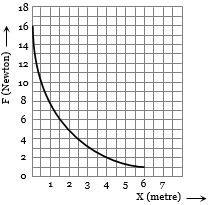
The relation between the displacement $X$  of an object produced by the application of the variable force $F$ is represented by a graph shown in the figure. If the object undergoes a displacement from $X = 0.5\,m$ to $X = 2.5\,m$ the work done will be approximately equal to .............. $J$
In Young’s double slit experiment, the $8^{th}$ maximum with wavelength ${\lambda _1}$ is at a distance ${d_1}$ from the central maximum and the $6^{th}$ maximum with a wavelength ${\lambda _2}$ is at a distance ${d_2}.$ Then $({d_1}/{d_2})$ is equal to
Three very large plates of same area are kept parallel and close to each other. They are considered as ideal black surfaces and have very high thermal conductivity. The first and third plates are maintained at temperatures $2\ T$ and $3\ T$ respectively. The temperature of the middle ($i.e.$ second) plate under steady state condition is
The mass density of a planet of radius $R$ varies with the distance $r$ from its centre as $\rho( r )=\rho_{0}\left(1-\frac{ r ^{2}}{ R ^{2}}\right) .$ Then the gravitational field is maximum at
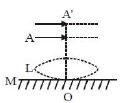
A thin convex lens $L$ (refractive index $= 1.5$) is placed on a plane mirror $M$. When a pin is placed at $A$, such that $OA = 18\, cm$, its real inverted image is formed at $A$ itself, as shown in figure. When a liquid of refractive index ${\mu _1}$ is put between the lens and the mirror, the pin has to be moved to $A’$. such that $OA’ = 27\,cm$, to get its inverted real image at $A'$ itself. The value of ${\mu _1}$ will be
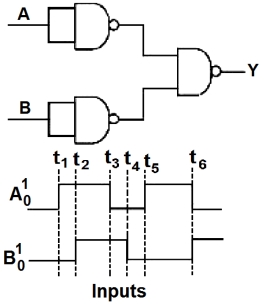
The output waveform of the given logical circuit for the following inputs $A$ and $B$ as shown below, is:
With increasing biasing voltage of a photodiode, the photocurrent magnitude