Question
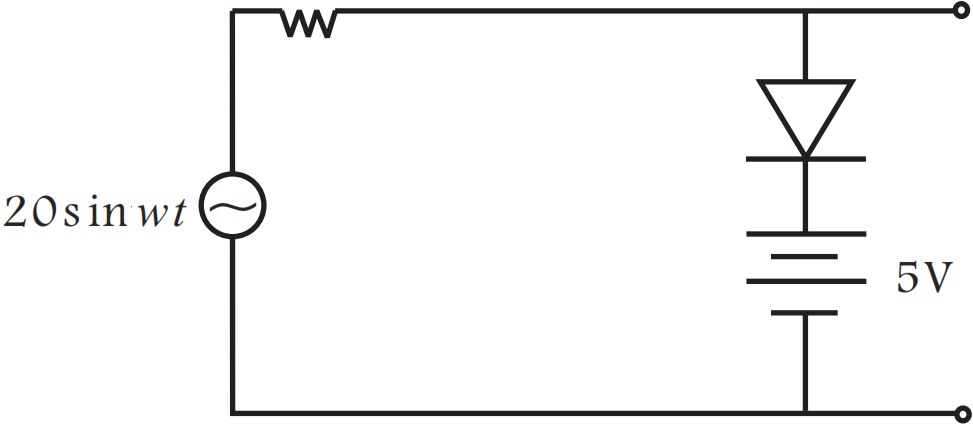
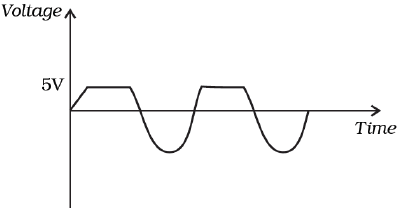
Assuming the ideal diode, draw the output waveform for the circuit given in Fig. Explain the waveform.

Answer

An ideal diode behaves like a perfect conductor when voltage is applied forward biased and like a perfect insulator when voltage is applied reverse biased.
When input voltage is greater than 5V, diode is conducting
When input is less than 5V, diode is open
The correct diagram is shown below:

Need a full question paper?

Generate a complete, print-ready paper with questions like this in minutes — across 16+ boards, with answer keys.
Start Generating Free

Similar questions

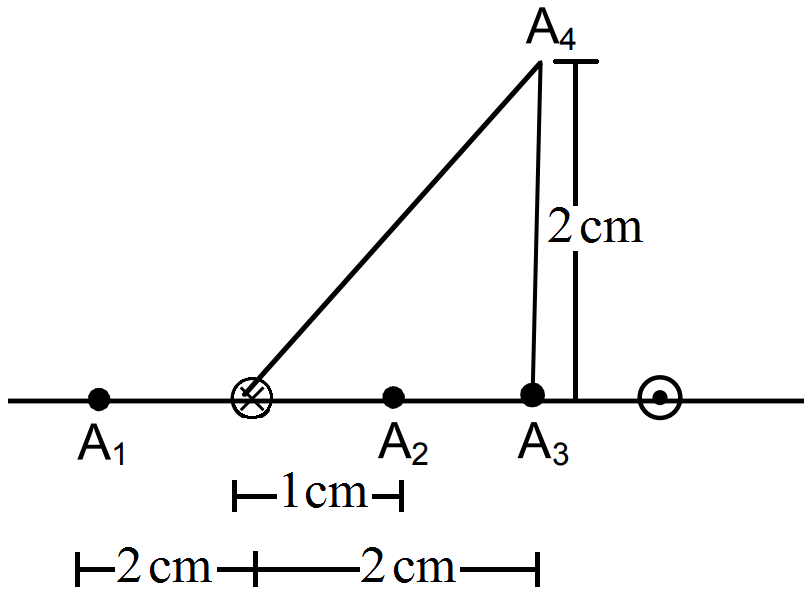
Figure shows two parallel wires separated by a distance of 4.0cm and carrying equal currents of 10A along opposite directions. Find the magnitude of the magnetic field B at the points A1, A2, A3 and A4.

The conductivity of an intrinsic samiconductor depends on temperature as $\sigma=\sigma_0\text{ e}^{\frac{-\Delta\text{E}}{2\text{kT}}}$ where $\sigma_0$ is a constant. Find the temperature at which the conductivity pf an intrinsic germanium semiconductor will be double of its value at T = 300K. Assume that the gap for germanium is 0.650eV and remains constant as the temperature is increased.
When a p-n junction is reverse-biased, the current becomes almost constant at $25\mu\text{A}.$ When it is forwardbiased at 200mV, a current of $75\mu\text{A}$ is obtained. Find the magnitude of diffusion current when the diode is,
  1. Unbiased.
  2. Reverse-biased at 200mV.
  3. Forward-biased at 200mV.
In an experiment with Foucault's apparatus, the various distances used are as follows:
Distance between the rotating and the fixed mirror = 16m
Distance between the lens and the rotating mirror = 6m
Distance between the source and the lens = 2m
When the mirror is rotated at a speed of 356 revolutions per second, the image shifts by 0.7mm. Calculate the speed of light from these data.
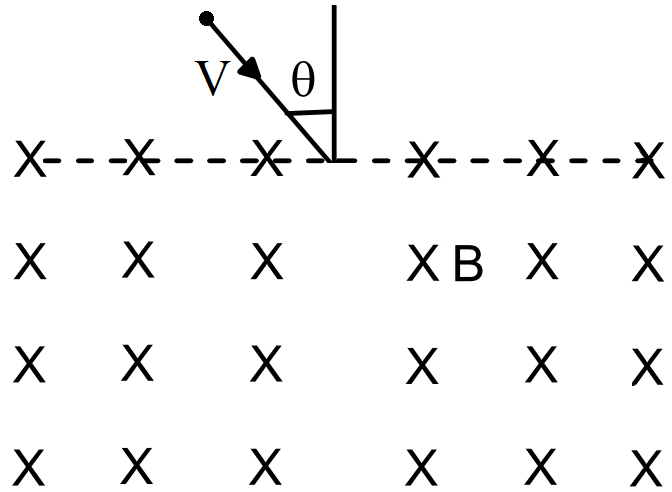
A particle of mass m and positive charge q, moving with a uniform velocity v, enters a magnetic field B, as shown,
  1. Find the radius of the circular arc it describes in the magnetic field.
  2. Find the angle subtended by the arc at the centre.
  3. How long does the particle stay inside the magnetic field?
  4. Solve the three parts of the above problem if the charge q on the particle is negative.

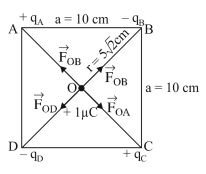
Four point charges $q_{ A }=2 \mu C$,$q_{ B }=-5 \mu C , q_{ C }=2 \mu C$ and $q_{ D }=-5 \mu C$ are located at the of a square ABCD of side 10 cm. Wht is the force on a charge of $1 \mu C$ placed at the centre of the square?
Image
An adiabatic vessel of total volume V is divided into two equal parts by a conducting separator. The separator is fixed in this position. The part on the left contains one mole of an ideal gas (U = 1.5nRT) and the part on the right contains two moles of the same gas. Initially, the pressure on each side is p. The system is left for sufficient time so that a steady state is reached. Find,
  1. The work done by the gas in the left part during the process.
  2. The temperature on the two sides in the beginning.
  3. The final common temperature reached by the gases.
  4. The heat given to the gas in the right part.
  5. The increase in the internal energy of the gas in the left part.
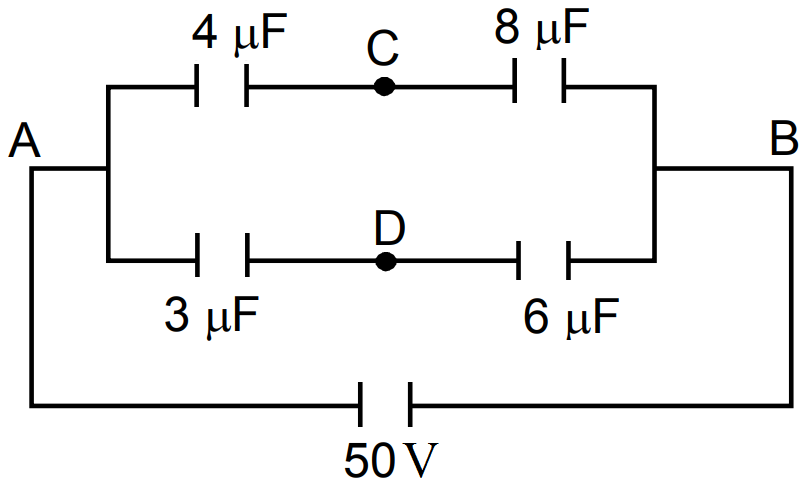
Take the potential of the point B in figure to be zero:
  1. Find the potentials at the points C and D.
  2. If a capacitor is connected between C and D, what charge will appear on this capacitor?

Two long, straight wires, each carrying a current of 5A, are placed along the X and Y-axes respectively. The currents point along the positive directions of the axes. Find the magnetic fields at the points (a) (1m, 1m), (b) (-1m, 1m), (c) (-1m,-1m) and (d) (1m, -1m),
A biconvex thick lens is constructed with glass $(\mu=1.50)$ Each of the surfaces has a radius of 10cm and the thickness at the middle is 5cm. Locate the image of an object placed far away from the lens.