Question
Asteroids are

Answer

(a)Asteroids are a group of rock pieces moving around the Sun in between Mars and Jupiter. They are believed to be the remains of a large planet which exploded due to gravitative attraction of Sun and that planet, may be called small planets.

Need a full question paper?

Generate a complete, print-ready paper with questions like this in minutes — across 16+ boards, with answer keys.
Start Generating Free

Similar questions

The acceleration of an electron in the first orbit of the hydrogen atom $(z\, = 1)$ is
A particle of mass $2 \,kg$ travels along a straight line with velocity $v=a \sqrt{x}$, where $a$ is a constant. The work done by net force during the displacement of particle from $x=0$ to $x=4 \,m$ is .........
A galvanometer of resistance, $G,$ is connected in a circuit. Now a resistance $R$ is connected in series of galvanometer. To keep the main current in the circuit unchanged, the resistance to be put in parallel with the series combination of $G$ and $R$ is
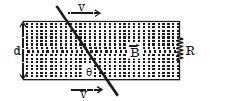
A conducting rod with resistance $r$ per unit  length is moving inside a vertical magnetic field $\vec B$ at constant speed $v$ on two horizontal parallel ideal conductor rails.The ends of the rails ae connected to a resistor $R.$ The separation between the rails is $d.$ The rod maintains a tilted angle $\theta$ to the rails. Find the external force required to keep the rod moving.
The energy band gap of $Si$ is........$eV$
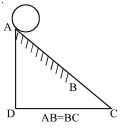
Portion $AB$ of the wedge shown in figure is rough and $BC$ is smooth. $A$ solid cylinder rolls without slipping from $A$ to $B$. The ratio of translational kinetic energy to rotational kinetic energy, when the cylinder reaches point $C$ is :
A particle of mass $m$ moves in a circular path of radius $r$, under the action of force which delivers it constant power $p$ and increases its speed. The angular acceleration of particle at time $(t)$ is proportional
If in a nuclear fusion process the masses of the fusing nuclei be ${m_1}$ and ${m_2}$ and the mass of the resultant nucleus be ${m_3}$, then
Steel wire of length ' $L$ ' at $40^{\circ} C$ is suspended from the ceiling and then a mass ' $m$ ' is hung from its free end. The wire is cooled down from $40^{\circ} C$ to $30^{\circ} C$ to regain its original length ' $L$ '. The coefficient of linear thermal expansion of the steel is $10^{-5} /{ }^{\circ} C$, Young's modulus of steel is $10^{11} N / m ^2$ and radius of the wire is $1 \ mm$. Assume that $L \gg$ diameter of the wire. Then the value of ' $m$ ' in $kg$ is nearly
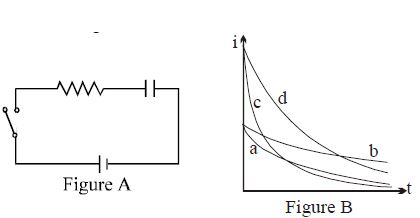
After the switch shown in figure $A$ is closed, there is current $i$ through resistance $R$. Figure $B$ indicates current variation curves $a, b, c$ and $d$ for four sets of values of $R$ and capacitance $C$:
$(i)$ $R_0$ and $C_0$,        $(ii)$ $2R_0$ and $C_0$,
$(iii)$ $R_0$ and $2C_0$,    $(iv)$ $2R_0$ and $2C_0$.
Which set goes with which curve?