MCQ
At a given temperature the root mean square velocities of oxygen and hydrogen molecules are in the ratio
  • A
    $16:1$
  • B
    $1:16$
  • C
    $4:1$
  • $1:4$

Answer

Correct option: D.
$1:4$
d
${v_{rms}} \propto \frac{1}{{\sqrt M }};$

$\therefore$  $\frac{{{{({v_{rms}})}_{{O_2}}}}}{{{{({v_{rms}})}_{{H_2}}}}} = \sqrt {\frac{{{M_{{H_2}}}}}{{{M_{{O_2}}}}}}  = \sqrt {\frac{2}{{32}}}  = 1:4$

Need a full question paper?

Generate a complete, print-ready paper with questions like this in minutes — across 16+ boards, with answer keys.

Start Generating Free

Similar questions

$STATEMENT-1$ The sensitivity of a moving coil galvanometer is increased by placing a suitable magnetic material as a core inside the coil. and

$STATEMENT-2$ Soft iron has a high magnetic permeability and cannot be easily magnetized or demagnetized
Consider a point $P$ on the circumference of a disc rolling along a horizontal surface. If $R$ is the radius of the disc, the distance through which $P$ moves in one full rotation of the disc is
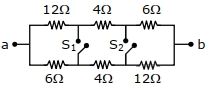
In the given figure switches $S_{1}$ and $S_{2}$ are in open condition. The resistance across $a b$ when the switches $S_{1}$ and $S_{2}$ are closed is $...\,\Omega$
The half life period of radioactive element ${x}$ is same as the mean life time of another radioactive element $y.$ Initially they have the same number of atoms. Then:
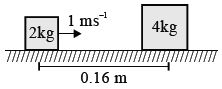
The friction coefficient between the horizontal surface and each of the block shown in  figure is $0.2.$ The collision between the blocks is perfectly elastic. What is the  separation between the blocks when they come to rest :- .............. $\mathrm{cm}$
Find moment of inertia of a uniform annular disc of mass $100 \,g$, having inner radius $10\, cm$ and outer radius $20\, cm$, about an axis passing through its centre and perpendicular to its plane.
Interference fringes are observed on a screen by illuminating two thin slits $1 \,mm$ apart with a light source $(\lambda=632.8\, nm )$. The distance between the screen and the slits is $100\, cm$. If a bright fringe is observed on a screen at a distance of $1.27\, mm$ from the central bright fringe, then the path difference between the waves, which are reaching this point from the slits is close to$....\mu m$
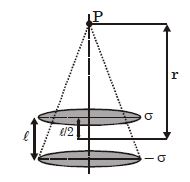
Two parallel disks each having radius $R$ are separated by a distance $l$ . The surface charge densities are $\sigma $ and $-\sigma $ . The electric field at point $P$ , a large distance $r$ along the axis of the disks is 
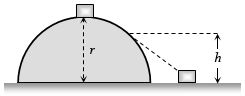
A small body of mass $m$ slides down from the top of a hemisphere of radius $r$. The surface of block and hemisphere are frictionless. The height at which the body lose contact with the surface of the sphere is
If we observe the single slit Fraunhofer diffraction with wavelength $\lambda$ and slit width $e$, the width of the central maxima is $2$$\theta$. On decreasing the slit width for the same $\lambda$