MCQ
At Curie temperature the ferromagnetic materials get converted into.
- ANon-magnetic material.
- BPara magnetic material.
- CDia magnetic material.
- DAll of the above.
Explanation:
Above curie temperature ferromagnetic material behaves like paramganetic materials. There magnetic susceptibilty starts varying linearly with temperature. Their I becomes too small above curies temperature.
Therefore, nature of ferrromagnetic materials becomes paramagnetic.
Generate a complete, print-ready paper with questions like this in minutes — across 16+ boards, with answer keys.
As a result of interference of two coherent sources of light, energy is
|
(a) Increased |
|
(b) Redistributed and the distribution does not vary with time |
|
(c) Decreased |
|
(d) Redistributed and the distribution changes with time |
Two wires ‘A’ and ‘B’ of the same material have their lengths in the ratio 1 : 2 and radii in the ratio 2 : 1. The two wires are connected in parallel across a battery. The ratio of the heat produced in ‘A’ to the heat produced in ‘B’ for the same time is
|
(a) 1 : 2 |
(b) 2 : 1 |
(c) 1 : 8 |
(d) 8 : 1 |
If the speed of light in vacuum is C m/sec, then the velocity of light in a medium of refractive index 1.5
|
(a) Is 1.5 × C |
(b) Is C |
|
(c) Is |
(d) Can have any velocity |
Two resistors are connected (a) in series (b) in parallel. The equivalent resistance in the two cases are 9 ohm and 2 ohm respectively. Then the resistances of the component resistors are
|
(a) 2 ohm and 7 ohm |
(b) 3 ohm and 6 ohm |
(c) 3 ohm and 9 ohm |
(d) 5 ohm and 4 ohm |
A triangular prism of glass is shown in the figure. A ray incident normally to one face is totally reflected, if θ = 45° . The index of refraction of glass is
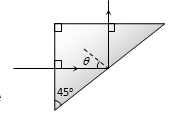
|
(a) Less than 1.41 |
(b) Equal to 1.41 |
(c) Greater than 1.41 |
(d) None of the above |
Which one of the following phenomena is not explained by Huygen's construction of wavefront
|
(a) Refraction |
(b) Reflection |
(c) Diffraction |
(d) Origin of spectra |
When the key K is pressed at time t = 0, which of the following statements about the current I in the resistor AB of the given circuit is true

|
(a) I = 2 mA at all t |
|
(b) I oscillates between 1 mA and 2mA |
|
(c) I = 1 mA at all t |
|
(d) At t = 0 , I = 2 mA and with time it goes to 1 mA |
