MCQ
At Curie temperature the ferromagnetic materials get converted into.
  • A
    Non-magnetic material.
  • Para magnetic material.
  • C
    Dia magnetic material.
  • D
    All of the above.

Answer

Correct option: B.
Para magnetic material.

Above curie temperature ferromagnetic material behaves like paramganetic materials. There magnetic susceptibilty starts varying linearly with temperature. Their I becomes too small above curies temperature.
Therefore, nature of ferrromagnetic materials becomes paramagnetic.

Need a full question paper?

Generate a complete, print-ready paper with questions like this in minutes — across 16+ boards, with answer keys.
Start Generating Free

Similar questions

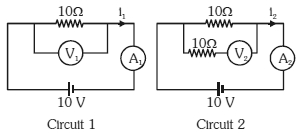
In the circuits shown below, the readings of the voltmeters and the ammeters will be
A battery of $24$ cells, each of emf $1.5\, V$ and internal resistance $2\, \Omega$ is to be connected in order to send the maximum current through a $12 \,\Omega$ resistor. The correct arrangement of cells will be
The ionisation potential of hydrogen atom is $13.6$ volt. The energy required to remove an electron from the second orbit of hydrogen is......$eV$
Infinite charges of magnitude $q$ each are lying at $x =1,\, 2,\, 4,\, 8...$ meter on $X$-axis. The value of intensity of electric field at point $x = 0$ due to these charges will be
The property which is not of an electromagnetic wave travelling in free space is that:
The electric field of plane electromagnetic wave of amplitude $2\,V/m$ varies with time, propagating along $z-$ axis. The average energy density of magnetic field (in $J/m^3$ ) is
With a change of load resistance of a triode, used as an amplifier, from $50 \,kilo\, ohms$ to $100 \,kilo \,ohms$, its voltage amplification changes from $25$ to $30$. Plate resistance of the triode is.....$k\, \Omega$
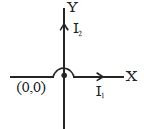
Two long straight conductors with currents $I_1$ and $I_2$ are placed along $X$ and $Y-$ axes. The equation of locus of points of zero magnetic induction is 
Wires $P$ and $Q$ have the same resistance at ordinary (room) temperature. When  heated, resistance of $P$ increase and that of $Q$ decreases. We conclude that
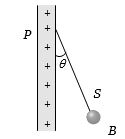
A charged ball $B$ hangs from a silk thread $S$, which makes an angle $\theta $ with a large charged conducting sheet $P$, as shown in the figure. The surface charge density $\sigma $ of the sheet is proportional to