MCQ
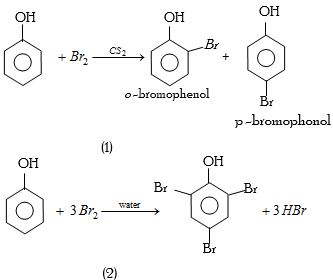
At low temperature phenol reacts with $B{r_2}$ in $C{S_2}$ to form
  • A
    $m-$ bromophenol
  • $o-$ and $ p-$ bromophenol
  • C
    $p$-bromophenol
  • D
    $2, 4, 6 $-tribromophenol

Answer

Correct option: B.
$o-$ and $ p-$ bromophenol
b
(b) (1)

In presence of non-polar solvent $(C{S_2})$ the ionization of phenol is suppressed. The ring is slightly activated and hence mono substitution occurs.

On the other hand with $B{r_2}$ water phenol forms $ 2,4,6$ -tribromo phenol.

(2)

In aqueous solution phenol ionizes to give phenoxide ion. Due to the presence of negative charge on oxygen the benzene ring is highly activated and hence trisubstituted product is obtained.
Need a full question paper?

Generate a complete, print-ready paper with questions like this in minutes — across 16+ boards, with answer keys.

Start Generating Free

Similar questions

The normal $f.p.$ of nitrobenzene is $278.82\, K$. If a non-volatile solute is dissolved in it and a solution of $0.25$ molality is prepared. The observed $f.p.$ of the solution is $276.82\, K$. Evaluate $K_f$ of nitrobenzene ............ $K\,Kg\,mol{e^{ - 1}}$.
Which of the following is not a monosaccharide?
Which of the following compound will not give Iodoform Test
Which of the following compound will behave as a reducing sugar in $aq.KOH$ solution ?
Which of the following is most acidic
$\mathop {Xe + {F_2}}\limits_{\left( {1:20} \right)} \xrightarrow{{573\,K,60 - 70\,bar}}A$ 

What is $A$

$\begin{matrix}
   Ph-C{{H}_{2}}-CH-C{{H}_{3}}\xrightarrow{K}\xrightarrow{{{C}_{2}}{{H}_{5}}Br}(A)  \\
   |\,\,\,\,\,\,\,\,\,\,\,\,\,\,\,\,\,\,\,\,\,\,\,\,\,\,\,\, \\
   OH\,\,\,\,\,\,\,\,\,\,\,\,\,\,\,\,\,\,\,\,\,\,\,\,\,\,  \\
\end{matrix}$

Product $(A)$ in above reaction is

Which of the following parameters is never affected by using a catalyst during a reaction?
Assertion : Iodine is more soluble in water than in carbon tetrachloride.

Reason : Iodine is a polar compound.

Two compounds $A$ and $B$ with same molecular formula $\left( C _{3} H _{6} O \right)$ undergo Grignard's reaction with methylmagnesium bromide to give products $C$ and $D$. products $C$ and $D$ show following chemical tests.

Test $C$ $D$
Ceric ammonium nitrate Test Positive positive
Lucas Test Turbidity obtained after five minutes Turbidity obtained immediately
Iodoform Test Positive Negative

$C$ and $D$ respectively are