MCQ
At neutral temperature, the thermoelectric power $\left(\frac{\mathrm{dE}}{\mathrm{dT}}\right)$ has the value
  • Zero
  • B
    Maximum but negative
  • C
    Maximum but positive
  • D
    Minimum but positive

Answer

Correct option: A.
Zero
(a) Zero

Need a full question paper?

Generate a complete, print-ready paper with questions like this in minutes — across 16+ boards, with answer keys.
Start Generating Free

Similar questions

Which radiations will be most effective for the emission of electrons from a metallic surface?
To reduce the value of capacitance of a parallel plate capacitor, the empty space between the plates:
When the current through the electromagnet of a relay reaches a particular value.
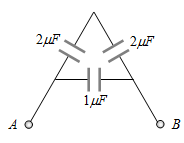
What is the effective capacitance between A and B in the following figure
A potential difference of $V$ is applied at the ends of a copper wire of length $l$ and diameter $d$. On doubling only $d$, drift velocity
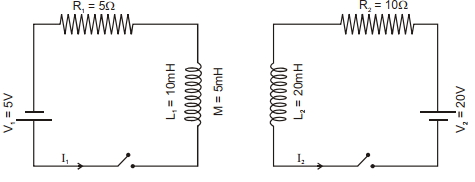
The inductors of two $L R$ circuits are placed next to each other, as shown in the figure. The values of the self-inductance of the inductors, resistances, mutual-inductance and applied voltages are specified in the given circuit. After both the switches are closed simultaneously, the total work done by the batteries against the induced $E M F$ in the inductors by the time the currents reach their steady state values is. . . . . $mJ$
A constant voltage is applied between the two ends of a metallic wire. If both the length and the radius of the wire are doubled, the rate of heat developed in the wire
A charge $+q$ is distributed over a thin ring of radius $r$ with line charge density $\lambda=q \sin ^{2} \theta /(\pi r)$. Note that the ring is in the $X Y$ - plane and $\theta$ is the angle made by $r$ with the $X$-axis. The work done by the electric force in displacing a point charge $+ Q$ from the centre of the ring to infinity is
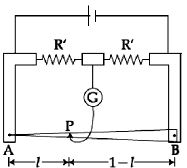
In a meter bridge, the wire of length $1\, m$ has a nonuniform cross-section such that, the variation $\frac{{dR}}{{d\ell }}$ of its resistance $R$ with length $\ell $ is $\frac{{dR}}{{d\ell }} \propto \frac{1}{{\sqrt \ell  }}$ Two equal resistances are connected as shown in the figure. The galvanometer has zero deflection when the jockey is at point $P$. What is the length $AP$ ? ................ $m$
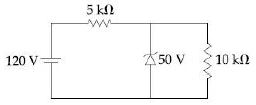
For the circuit shown below, the current through the Zener diode is......$mA$