MCQ
At nodes in stationary waves
  • Change in pressure and density are maximum
  • B
    Change in pressure and density are minimum
  • C
    Strain is zero
  • D
    Energy is minimum

Answer

Correct option: A.
Change in pressure and density are maximum
a
(a) In a longitudinal standing wave, such as in an organ pipe, there are fixed locations in the pipe where molecules oscillate back and forth at maximum amplitude, but there is no variation in $pressure- the$ density remains constant; this is a pressure node. At $1 / 4$ wavelength away from this node there is a pressure antinode, where the density alternates from high to low, with corresponding alternations in pressure. At the center of this antinode there is no particle motion, but particles on either side alternately move toward and away from the centre

Need a full question paper?

Generate a complete, print-ready paper with questions like this in minutes — across 16+ boards, with answer keys.

Start Generating Free

Similar questions

Measure of two quantities along with the precision of respective measuring instrument  $A = 2.5\,m{s^{ - 1}} \pm 0.5\,m{s^{ - 1}}$, $B = 0.10\,s \pm 0.01\,s$ The value of $AB$ will be
A particle of mass $m$ is thrown horizontally from the top of a tower and another particle of mass $2 \,m$ is thrown vertically upward. The acceleration of centre of mass is .............
A body of weight w1 is suspended from the ceiling of a room through a chain of weight w2. The ceiling pulls the chain by a force:
  1. w1
  2. w2
  3. w1 + w2
  4. $\frac{\text{w}_1+\text{w}_2}{2}$
A boy having a mass equal to $40$ kilograms is standing in an elevator. The force felt by the feet of the boy will be greatest when the elevator$(g = 9.8\,metres/{\sec ^2})$
Three observers A, B and C measure the speed of light coming from a source to be vA, 0B and vc. The observer A moves towards the source and C moves away from the source at the same speed. The observer B stays stationary. The surrounding space is vacuum everywhere.

  1. $\text{v}_\text{A}>\text{v}_\text{B}>\text{v}_\text{C}.$

  2. $\text{v}_\text{A}<\text{v}_\text{B}<\text{v}_\text{C}$

  3. $\text{v}_\text{A}=\text{v}_\text{B}=\text{v}_\text{C}$

  4. $\text{v}_\text{B}=\frac{1}{2}(\text{v}_\text{A}+\text{v}_\text{C})$
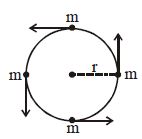
Four similar particles of mass $m$ are orbiting in a circle of radius $r$ in the same  direction because of their mutual gravitation attractive force. Velocity of a particle is  given by
$P-V$ diagram of a diatomic gas is a straight line passing through origin. The molar heat capacity of the gas in the process will be
A source of sound placed at the open end of a resonance column sends an acoustic wave of pressure amplitude ${\rho _0}$ inside the tube. If the atmospheric pressure is ${\rho _A},$ then the ratio of maximum and minimum pressure at the closed end of the tube will be
A tuning fork $A$ of frequency $200 Hz$ is sounded with fork $B,$ the number of beats per second is $5.$ By putting some wax on $A,$ the number of beats increases to $8.$ The frequency of fork $B$ is  .... $Hz$
An isolated rail car originally moving with speed $v_0$ on a straight, frictionles, level track contains a large amount of sand. $A$ release valve on the bottom of the car malfunctions, and sand begins to pour out straight down relative to the rail car. What happens to the speed of the rail car as the sand pours out?