Question
At noon the sun appears white because:

Answer

  1. Light is least scattered.
Explanation:
At noon because the sun is overhead, the light is scattered the least and hence appears white. When it is overhead, it has lesser air to travel through and the scattering from dust and other particles is reduced if the distance to be travelled in air is reduced.

Need a full question paper?

Generate a complete, print-ready paper with questions like this in minutes — across 16+ boards, with answer keys.
Start Generating Free

Similar questions

A hole in a P-type semiconductor is(a) An excess electron(b) A missing electron(c) A missing atom(d) A donor level
   
   
The wing span of an aeroplane is $20$ metre. It is flying in a field, where the vertical component of magnetic field of earth is $5 \times 10^{–5}$ tesla, with velocity $360 \ km/h$. The potential difference produced between the blades will be
Positive electric flux indicates that electric lines of force are directed:
The energy of a hydrogen atom in its ground state is -13.6eV. The energy of the level corresponding to the quantum number n = 2 (first excited state) in the hydrogen atom is(a) – 2.72 eV(b) – 0.85 eV(c) – 0.54 eV(d) – 3.4 eV
       
The equivalent inductance of two inductances is 2.4 henry when connected in parallel and 10 henry when connected in series. The difference between the two inductances is(a) 2 henry(b) 3 henry(c) 4 henry(d) 5 henry
       
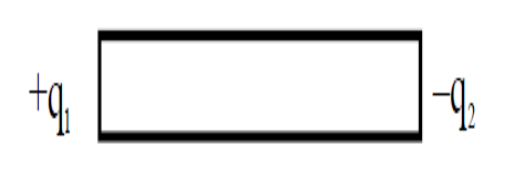
A thin insulator rod is placed between two unlike point charges $+q_1$​ and $q_2​$. For this situation tick the correct alternative $(s):$​​​​​​​
A parallel monochromatic beam of light is incident normally on a narrow slit. A diffraction pattern is formed on a screen placed perpendicular to the direction of incident beam. At the first maximum of the diffraction pattern the phase difference between the rays coming from the edges of the slit is 
A proton of energy $200\ MeV$ enters the magnetic field of $5 T.$ If direction of field is from south to north and motion is upward, the force acting on it will be
A photon of energy $8\ eV$ is incident on a metal surface of threshold frequency $1.6 \times 10^{15} \mathrm{~Hz}$, then the maximum kinetic energy of photoelectrons emitted is $\left(\mathrm{h}=6.6^{\times 10^{-34} \mathrm{Js}}\right)$
When a beam of accelerated electrons hits a target, a continuous X-ray spectrum is emitted from the target. Which of the following wavelength is absent in the X-ray spectrum, if the X-ray tube is operating at 40,000 volts(a) 0.25 Å(b) 0.5 Å(c) 1.5 Å  (d) 1.0 Å