MCQ
At the equilibrium position in the process of adsorption $.......$
  • A
    $\triangle\text{H}>0$
  • $\triangle\text{H}=\text{T}\triangle\text{S}$
  • C
    $\triangle\text{H}>\text{T}\triangle\text{S}$
  • D
    $\triangle\text{H}<\text{T}\triangle\text{S}$

Answer

Correct option: B.
$\triangle\text{H}=\text{T}\triangle\text{S}$
At equilibrium position adsorption$, \triangle\text{G}=\triangle\text{H}-\text{T}\triangle\text{S}=0$ so that $\triangle\text{H}=\text{T}\triangle\text{H}.$

Need a full question paper?

Generate a complete, print-ready paper with questions like this in minutes — across 16+ boards, with answer keys.

Start Generating Free

Similar questions

Which is the best method for preparation of the $N$ -methyl ethanamide?
The Total pressure observed by mixing two liquid $A$ and $B$ is $350\,mm\,Hg$ when their mole fractions are $0.7$ and $0.3$ respectively.The Total pressure becomes $410 \,mm\,Hg$ if the mole fractions are changed to $0.2$ and $0.8$ respectively for $A$ and $B$. The vapour pressure of pure $A$ is $...........\,mm\,Hg$. (Nearest integer)

Consider the liquids and solutions behave ideally.
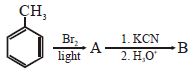
In the following compounds, the decreasing order of basic strength will be
What is the final product $(B)$ of this sequence
Will $F{e_{(s)}}$be oxidised to $F{e^{2 + }}$ by the reaction with $1\,M $ $HCl$ $({E^o}$ for $Fe/F{e^{2 + }}$ $= + 0.44\,V)$
In electrolysis, if the duration of the passage of current is doubled, the mass liberated is
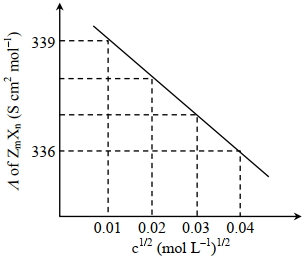
Consider the strong electrolytes $Z _{ m } X _{ n }, U _{ m } Y _{ p }$ and $V _{ m } X _{ n }$. Limiting molar conductivity $\left(\Lambda^0\right)$ of $U _{ m } Y _{ p }$ and $V _{ m } X _{ n }$ are $250$ and $440 S cm ^2 mol ^{-1}$, respectively. The value of $( m + n + p )$ is . . . . .Given:

$Ion$ $Z ^{ n +}$ $Z ^{ P +}$ $Z ^{ n +}$ $Z ^{ m +}$ $Z ^{ m +}$
$\lambda^0\left( S cm ^2 mol ^{-1}\right)$ $50.0$ $25.0$ $100.0$ $80.0$ $100.0$

$\lambda^0$ is the limiting molar conductivity of ions

The plot of molar conductivity $(4)$ of $Z _{ m } X _{ n } v s c ^{1 / 2}$ is given below.
Nitrous oxide is known as
Consider the following first order gas phase reaction at constant temperature

$\mathrm{A}(\mathrm{g}) \rightarrow 2 \mathrm{~B}(\mathrm{~g})+\mathrm{C}(\mathrm{g})$

If the total pressure of the gases is found to be $200$ torr after $23 \mathrm{sec}$. and $300$ torr upon the complete decomposition of $\mathrm{A}$ after a very long time, then the rate constant of the given reaction is . . . . . .$\times 10^{-2} \mathrm{~s}^{-1}$ (nearest integer)

[Given : $\log _{10}(2)=0.301$ ]

Rate constant for a chemical reaction taking place at $500\, K$, is expressed as $K = A\, e^{-1000}$. The activation energy of the reaction is