MCQ
At time $t=0$, a container has $N_{0}$ radioactive atoms with a decay constant $\lambda$. In addition, $c$ numbers of atoms of the same type are being added to the container per unit time. How many atoms of this type are there at $t=T$ ?
  • A
    $\frac{c}{\lambda} \exp (-\lambda  T)-N_0 \exp (-\lambda T)$
  • B
    $\frac{c}{\lambda} \exp (-\lambda T)+N_0 \exp (-\lambda T)$
  • $\frac{c}{\lambda}(1-\exp (-\lambda  T))+N_0 \exp (-\lambda T)$
  • D
    $\frac{c}{\lambda}(1+\exp (-\lambda T))+N_0 \exp (-\lambda T)$

Answer

Correct option: C.
$\frac{c}{\lambda}(1-\exp (-\lambda  T))+N_0 \exp (-\lambda T)$
c
(c)

Net decay rate of active nuclii is

$\frac{d N}{d t}=c-\lambda N$

$\Rightarrow \quad \frac{d N}{c-\lambda N}=d t$

Integrating both sides, we get

$\int \frac{d N}{c-\lambda N}=\int d t \quad \dots(i)$

Now, $\quad c-\lambda N=u$

Differentiating,

$-\lambda d N=d u$

above equation, we have

$d N=\frac{d x}{-\lambda} \quad \dots(i)$

Substituting is Eq. $(i)$, we get

$\frac{-1}{\lambda} \int \frac{d u}{u}=\int d t$

$\Rightarrow -\frac{1}{\lambda} \log u=t+k$

where, $k$ is constant of integration.

$\Rightarrow -\frac{1}{\lambda} \log (c-\lambda N)=t+k \quad \dots(ii)$ 

Now, at $t=0$ and $N=N_0$,

So, $\frac{-1}{\lambda} \log \left(c-\lambda N_{0}\right)=k$.

Substituting for $k$ in Eq. $(ii)$, we get

$-\frac{1}{\lambda} \log (c-\lambda N)=t-\frac{1}{\lambda} \log$

$\left(c-\lambda N_0\right)$

$\log \left(\frac{c-\lambda N}{c-\lambda N_{0}}\right)=-\lambda t$

Taking antilog we get,

$\frac{c-\lambda N}{c-\lambda N_0}=e^{-\lambda t}$

$\Rightarrow c-\lambda N=\left(c-\lambda N_0\right) e^{-\lambda t}$

Solving for $N$, we get

$\Rightarrow \quad N=\frac{c}{\lambda}\left(1-e^{-\lambda t}\right)+N_0 e^{-\lambda t}$
Need a full question paper?

Generate a complete, print-ready paper with questions like this in minutes — across 16+ boards, with answer keys.

Start Generating Free

Similar questions

In $a$ circuit containing an inductance of zero resistance, the $e.m.f$. of the applied $ac$ voltage leads the current by ......$^o$
A prism of refractive index $\mu$ and angle $A$ is placed in the minimum deviation position. If the angle of minimum deviation is $A,$ then the value of $A$ in terms of $\mu$ is
When a shunt of $4\,\Omega $ is attached to a galvanometer the deflection reduces to $\frac{1}{5} th$. If an additional shunt of $4\,\Omega $ is attached. What will be the deflection.
Due to the earth's magnetic field, charged cosmic ray particles
The specific resistance of manganin is $50 \times 10^{-8} ohm\times m$. The resistance of a cube of length 50 cm will be
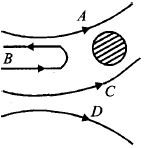
In the Rutherford experiment, $\alpha -$ particles are scattered from a nucleus as shown. Out of the four paths, which path is not possible?
An electron is moving along the positive $x$-axis. If the uniform magnetic field is applied parallel to the negative $z$-axis. then

$A.$ The electron will experience magnetic force along positive $y$-axis

$B.$ The electron will experience magnetic force along negative $y$-axis

$C.$ The electron will not experience any force in magnetic field

$D.$ The electron will continue to move along the positive $x$-axis

$E.$ The electron will move along circular path in magnetic field

Choose the correct answer from the options given below:

A uniform magnetic field exists in region given by $\vec B = 3\hat i + 4\hat j + 2\hat k$. A conducting rod of length $5\,m$ is placed along $y-$ axis is moved along $x-$ axis with constant speed $1\,m/sec$. The $emf$ induced in the rod will be......$V$
The mobility of free electron is greater than that of free holes because
The output voltage (taken across the resistance) of a $L-C-R$ series resonant circuit falls to half its peak value at a frequency of $200 \,Hz$ and again reaches the same value at $800 \,Hz$. The bandwidth of this circuit is ............. $\,Hz$