Question
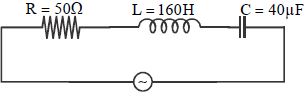
At what angular frequency $\omega $ the following circuit consumes maximum power?.......$rad/s$
Answer

$\omega=\frac{1}{\sqrt{\mathrm{LC}}}=\frac{1}{\sqrt{160 \times 40 \times 10^{-6}}}=\frac{1}{\sqrt{6400 \times 10^{-6}}}$

$\frac{1}{80 \times 10^{-3}}=\frac{1000}{80}=12.5 \mathrm{\,rad} / \mathrm{s}$

Need a full question paper?

Generate a complete, print-ready paper with questions like this in minutes — across 16+ boards, with answer keys.
Start Generating Free

Similar questions

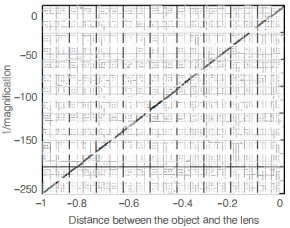
The following graph depicts the inverse of magnification versus the distance between the object and lens data for a setup. The focal length of the lens used in the setup is .................... $m$
When a metal surface is illuminated by light of wavelength $\lambda$, the stopping potential is $8 \mathrm{~V}$. When the same surface is illuminated by light of wavelength $3 \lambda$, stopping potential is $2 \mathrm{~V}$. The threshold wavelength for this surface is :
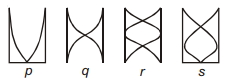
The vibrations of four air columns under identical conditions are represented in the figure below. The ratio of frequencies $n_p: n_q: n_r: n_s$ will be
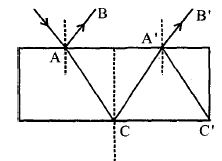
A ray of light of intensity $I$ is incident on a parallel glass slab at point $A$ as shown in diagram. It undergoes partial reflection and refraction. At each reflection, $25\%$ of incident energy is reflected. The rays $AB$ and $A'B'$ undergo interference. The ratio of $I_{max}$ and $I_{min}$ is
When there is an electric current through a conducting wire along its length, then an electric field must exist
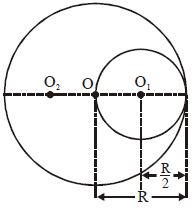
A spherical hollow is made in a lead sphere of radius $R,$ such that its surface touches the outside surface of lead sphere and passes through the centre. What is the shift in the centre of mass of lead sphere due to the following ?
Number of nuclei of a radioactive substance at time $t = 0$ are $1000$ and $900$ at time $t = 2$ $s$. Then number of nuclei at time $t = 4$ $s$ will be
$\underset{{{C}_{7}}{{H}_{14}}}{\mathop{(A)}}\,\xrightarrow[Zn/AcOH]{{{O}_{3}}}(B)+(C)$

Compound $(A)$ exist in geometrical isomers and $(B)$ gives Cannizaro reaction. $(A)$ will be

The maximum elongation of a steel wire of $1 \mathrm{~m}$ length if the elastic limit of steel and its Young's modulus, respectively, are $8 \times 10^8 \mathrm{~N} \mathrm{~m}^{-2}$ and $2 \times 10^{11} \mathrm{~N} \mathrm{~m}^{-2}$, is:
A charge $Q$ is uniformly distributed over a large square plate of copper. The electric  field at a point very close to the centre of the plane is $10\, V/m$. If the copper plate is  replaced by a plastic plate of the same geometrical dimensions and carrying the same  charge $Q$ uniformly distributed, then the electric field at the point $P$ will be......$V/m$