MCQ
At what temperature the centigrade (Celsius) and Fahrenheit, readings are the same ........ $^o$
  • $-40$
  • B
    $+ 40$
  • C
    $36.6$
  • D
    $-37$

Answer

Correct option: A.
$-40$
a
(a) $\frac{C}{5} = \frac{{F - 32}}{9}$ ==> $\frac{t}{5} = \frac{{t - 32}}{9}$ $\Rightarrow$ $t = - \,40^\circ $

Need a full question paper?

Generate a complete, print-ready paper with questions like this in minutes — across 16+ boards, with answer keys.

Start Generating Free

Similar questions

A sphere of mass $10\; kg$ and radius $0.5\; m$ rotates about a tangent. The moment of inertia of the sphere is
If velocity$(V)$, force$(F)$ and time$(T)$ are chosen as fundamental quantities then dimensions of energy are 
In the relation $P = \frac{\alpha }{\beta }{e^{ - \frac{{\alpha Z}}{{k\theta }}}}$ $P$ is pressure, $Z$ is the distance, $k$ is Boltzmann constant and $\theta$ is the temperature. The dimensional formula of $\beta$ will be
Which of the following units denotes the dimensions $\frac{{M{L^2}}}{{{Q^2}}}$, where $Q$
denotes the electric charge?
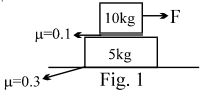
When $F = 2N$, the frictional force between $10 kg$ block and $5 kg$ block is ...... $N$
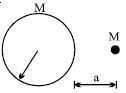
A particle of mass $M$ is at a distance a from surface of a thin spherical shell of equal mass and having radius a.
The scale on a steel meter rod is calibrated at 20°C. What will be the error in the reading of 50cm at 27°C? Take, $\alpha=1.2\times10^{-5}\ ^\circ\text{C}^{-1}.$
Two rods of different materials having coefficients of linear expansion ${\alpha _1},\,{\alpha _2}$ and Young's moduli ${Y_1}$ and ${Y_2}$ respectively are fixed between two rigid massive walls. The rods are heated such that they undergo the same increase in temperature. There is no bending of rods. If ${\alpha _1}:{\alpha _2} = 2:3$, the thermal stresses developed in the two rods are equally provided ${Y_1}:{Y_2}$ is equal to
A rocket has a mass of $100 \,kg$. $90\%$ of this is fuel. It ejects fuel vapours at the rate of $1 \,kg/sec$ with a velocity of $500\, m/sec$ relative to the rocket. It is supposed that the rocket is outside the gravitational field. The initial upthrust on the rocket when it just starts moving upwards  is ......... $N$
The displacement of a particle is given by x = (t - 2)2 where x is in metres and t in seconds. The distance covered by the particle in first 4 seconds is:
  1. 4m.
  2. 8m.
  3. 12m.
  4. 16m.