MCQ
Atomic radius of fcc is
  • A
     $\frac{a}{2}$
  • $\frac{a}{2 \sqrt{2}}$
  • C
     $\frac{\sqrt{3}}{4} a$
  • D
     $\frac{\sqrt{3}}{2} a$

Answer

Correct option: B.
$\frac{a}{2 \sqrt{2}}$

Need a full question paper?

Generate a complete, print-ready paper with questions like this in minutes — across 16+ boards, with answer keys.

Start Generating Free

Similar questions

The work functions of Silver and Sodium are $4.6$ and $2.3 \ eV$, respectively. The ratio of the slope of the stopping potential versus frequency plot for Silver to that of Sodium is :
Two point charges $-q$ and $+q$ are located at points $(0, 0, -a)$ and $(0, 0, a),$ respectively. The potential at a point $(0, 0, z)$ where $z > a$ is
A $16\, \Omega$ wire is bend to form a square loop. A $9 \,{V}$ supply having internal resistance of $1 \,\Omega$ is connected across one of its sides. The potential drop across the diagonals of the square loop is $.......\,\times 10^{-1} \,{V}$
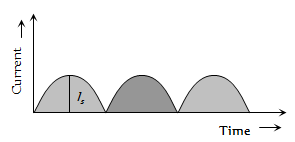
The output current versus time curve of a rectifier is shown in the figure. The average value of the output current in this case is

In a semiconductor, the forbidden energy gap between the valence band and the conduction band is of the order is:
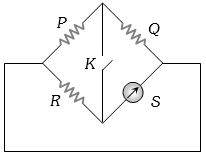
In the following Wheatstone bridge $P/Q = R/S$. If key $K$ is closed, then the galvanometer will show deflection
Three bulbs of 40W, 60W and 100W are arranged in series with 220V. Which bulb has minimum resistance
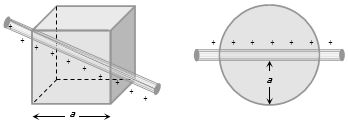
A linear charge having linear charge density $\lambda$ , penetrates a cube diagonally and then it penetrate a sphere diametrically as shown. What will be the ratio of flux coming cut of cube and sphere
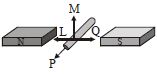
An electric potential difference will be induced between ends of the conductor shown in  the diagram, when the conductor moves in the direction
Two metal spheres of capacitances $C_1$ and $C_2$ carry some charges. They are put in contact and then separated. The final charges $Q_1$ and $Q_2$ on them will satisfy: