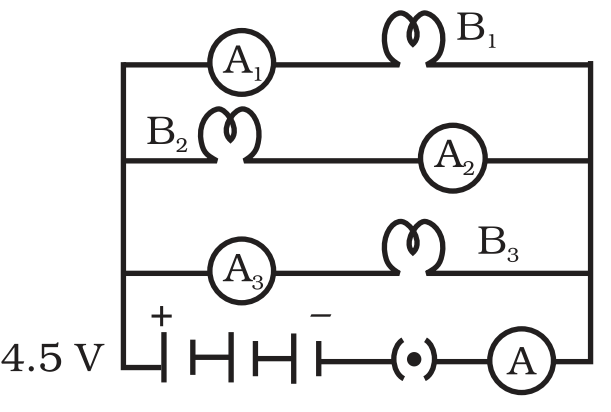
- What happens to the glow of the other two bulbs when the bulb B1 gets fused?
- What happens to the reading of A1, A2, A3 and A when the bulb B2 gets fused?
- How much power is dissipated in the circuit when all the three bulbs glow together?

When all bulbs glow, net resistnace of the circuit is given by,
$\frac{1}{\text{R}'}=\frac{1}{\text{R}}+\frac{1}{\text{R}}+\frac{1}{\text{R}}=\frac{3}{\text{R}}$
Or, $\text{R}'=\frac{\text{R}}{3}$
I = 3A, V = 4.5V
Using, V = IR', we get
$4.5=3\times\frac{\text{R}}{3}\ \text{or R }=4.5\Omega$
When B2 gets fused, only two bulbs B1 and B2 in parallel are in the circuit.
$\therefore$ Net resistance of the circuit is given by,
$\frac{1}{\text{R}}=\frac{1}{4.5}+\frac{1}{4.5}=\frac{2}{4.5}\ \text{or R }=\frac{4.5}{2}\Omega$
$\therefore\ \text{I}=\frac{\text{V}}{\text{R}}=\frac{4.5\times2}{4.5}=2\text{A}$
Thus, reading of ammeter A = 2A
Since B1 and B3 are in parallel and have same resistance, so 2A current will be equally distributed between B1 and B3. Therefore, reading of ammeter A1 = 1A Reading of ammeter A3 = 1A Circuit containing B2 is broken, so no current flows through this circuit. Hence reading of ammeter A2 = zero.
P = V × I
= 4.5 × 3 = 13.5W
Generate a complete, print-ready paper with questions like this in minutes — across 16+ boards, with answer keys.
You have two lenses A and B of focal lengths +10 cm and –10 cm respectively. State the nature and power of each lens. Which of the two lenses will form a virtual and magnified image of an object placed 8 cm from the lens? Draw a ray diagram to justify your answer.