(i) Write the equation for the reaction between baking soda and acid.
(ii) How does it help in extinguishing fire?
(iii) What is the reaction involved when it is heated?
or
(iv) Is the $pH$ value of baking soda solution lower than or higher than 7 ?
Generate a complete, print-ready paper with questions like this in minutes — across 16+ boards, with answer keys.
| K | Potassium | More reactive |
| Na | Sodium | |
| Ca | Calcium | |
| Mg | Magnesium | |
| Al | Aluminium | |
| Zn | Zinc | More reactive |
| Fe | Iron | |
| Pb | Lead | |
| [H] | [Hydrogen] | |
| Cu | Copper | |
| Hg | Mercury | |
| Ag | Silver | |
| Au | Gold | Least reactive |
As neutral atom carbon has electronic configuration $\text{K}\ \ \ \text{L}\\2\ \ \ \ 4$ To gain inert gas configuration carbon can either donate 4 valence electrons (helium gas configuration) or gain 4 electrons (neon gas configuration), but it cannot do so. To acquire inert gas configuration carbon can only share its 4 valence electrons with other atoms forming covalent bonds. A covalent bond can be defined as a chemical bond formed between two atoms by mutual sharing of valence electrons so that each atom acquires the stable electronic configuration of the nearest noble gas. The concept of covalent bonds was given by Langmuir and Lewis to explain bonding in non-ionic compounds. The covalent bonds are of three types. If each atom contributes one electron, the covalent bond formed is called a single covalent bond and is represented by a single line (-) and if each atom contributes two electrons, the covalent bond formed is called a double bond and is represented by a double line (=) and if each atom contributes three electrons, the covalent bond formed is called a triple bond and is represented by a triple line $(\equiv).$
Two allotropic forms of carbon which are crystalline in nature, are diamond and graphite. They differ physically but chemically they are similar. Diamond is the hardest crystalline form of carbon. In diamond, each carbon atom is linked to four other carbon atoms by covalent bonds. In graphite, each carbon atom is linked to three other carbon atoms by covalent bond. Graphite is relatively soft and greasy. It is also a good conductor of electricity. The C-C bond length in graphite is 141.5 pm while in diamond it is 154 pm.
| Metal | Iron (II) Sulphate | Copper (II) Sulphate | Zinc Sulphate | Silver Nitrate |
| A | No reaction | Displacement | ……………… | ……………… |
| B | Displacement | ……………… | No reaction | ……………… |
| C | No reaction | No reaction | No reaction | Displacement |
| D | No reaction | No reaction | No reaction | No reaction |

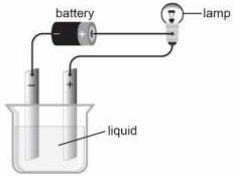
Mike observed whether the lamp in the circuit glowed or not for each liquid.
8. Which property of acids and bases was Mike trying to test through his experiment?
9. Will the lamp glow if the circuit is placed in distilled water?
Explain your answer.
10. Acid + Metal →Salt + X
What is X in the equation?
| S.NO | HINT |
| (i) | Substance 'C' is used as a preservative. |
| (ii) | 'C' has two carbon atoms; 'C' is obtained by the reaction of 'A' in presence of alkaline Potassium permanganate followed by acidification. |
| (iii) | Misuse of 'A' in industries is prevented by adding Methanol, Benzene, and pyridine to 'A'. |
| (iv) | 'F' is formed on heating 'A' in presence of conc Sulphuric acid. |
| (v) | 'F' reacts with Hydrogen gas in presence of Nickel and Palladium catalyst. |