MCQ
Barrier potential of a $P-N$ junction diode does not depend on
  • A
    Temperature
  • B
    Forward bias
  • C
    Doping density
  • Diode design

Answer

Correct option: D.
Diode design
d
(d) Barrier potential does not depends on diode design while barrier potential depends upon temperature, doping density, and forward biasing.

Need a full question paper?

Generate a complete, print-ready paper with questions like this in minutes — across 16+ boards, with answer keys.

Start Generating Free

Similar questions

A bomb projected from ground at an angle $\theta \, \left( {\theta  \ne {{90}^o}} \right)$ explodes into two fragments of equal mass at topmost point of it's trajectory. If one of the fragment returns to point of projection then ratio of De-broglie wavelength of second fragment just after explosion to bomb just before explosion is 
A charged water drop whose radius is $0.1\,\mu m$ is in equilibrium in an electric field. If charge on it is equal to charge of an electron, then intensity of electric field will be.......$N/C$ $(g = 10\,m{s^{ - 1}})$
A freshly prepared radioactive source of half life $2$ hours $30$ minutes emits radiation which is $64$ times the permissible safe level. The minimum time, after which it would be possible to work safely with source, will be hours.
Two light waves of intensities I and 4I, makes fringes by interference. The phase difference between the waves at point A of the screen is $\pi / 2$ and at point B is $\pi$. Then at point A and B the difference between the resulting intensities is :
Calculate the wavelength of electromagnetic waves of frequency $300\ MHz.$
The cathode rays have particle nature because of the fact that
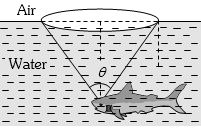
A fish is a little away below the surface of a lake. If the critical angle is $49^o ,$ then the fish could see things above the water surface within an angular range of ${\theta ^o}$ where
Two charges placed in air repel each other by a force of ${10^{ - 4}}\,N$. When oil is introduced between the charges, the force becomes $2.5 \times {10^{ - 5}}\,N$. The dielectric constant of oil is
A positive charge particle of $100 \,mg$ is thrown in opposite direction to a uniform electric field of strength $1 \times 10^{5} \,NC ^{-1}$. If the charge on the particle is $40 \,\mu C$ and the initial velocity is $200 \,ms ^{-1}$, how much distance (in $m$) it will travel before coming to the rest momentarily
The ionisation energy of hydrogen atom is 13.6 eV. Following Bohr's theory, the energy corresponding to a transition between the 3rd and the 4th orbit is