MCQ
Basically, the product modulator is
  • A
    An amplifier
  • A mixer
  • C
    A frequency separator
  • D
    A phase separator

Answer

Correct option: B.
A mixer
It mix weak signals with carrier signals.

Need a full question paper?

Generate a complete, print-ready paper with questions like this in minutes — across 16+ boards, with answer keys.

Start Generating Free

Similar questions

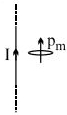
The magnetic dipole pm is placed parallel to an infinitely long straight wire as shown in figure
If $\lambda_{\text {max }}$ is $6563 \mathring A$, then wave length of second line for Balmer series will be
A cell of emf $6 \mathrm{~V}$ and resistance $0.5 \mathrm{ohm}$ is short circuited. The current in the cell is
In a dark room of photography, generally red light is used. The reason is
The radiant energy from the sun incident normally at the surface of earth is $20 \mathrm{kcal} / \mathrm{m}^2 \mathrm{~min}$. What would have been the radiant energy incident normally on the earth, if the sun had a temperature twice of the present one
A light and a heavy body have equal momenta. Which one has greater $K.E$
A spherical ball of mass $20 \mathrm{~kg}$ is stationary at the top of a hill of height $100 \mathrm{~m}$. It slides down a smooth surface to the ground, then climbs up another hill of height $30 \mathrm{~m}$ and finally slides down to a horizontal base at a height of $20 \mathrm{~m}$ above the ground. The velocity attained by the ball is
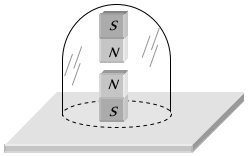
Two identical bar magnets with a length $10 \mathrm{~cm}$ and weight $50 \mathrm{gm}$ weight are arranged freely with their like poles facing in a inverted vertical glass tube. The upper magnet hangs in the air above the lower one so that the distance between the nearest pole of the magnet is $3 \mathrm{~mm}$. Pole strength of the poles of each magnet will beImage
Two particles of masses $m_1$ and $m_2$ in projectile motion have velocities $\vec{v}_1$ and $\vec{v}_2$ respectively at time $t=0$. They collide at time $t_0$. Their velocities become $\vec{v}_1{ }^{\prime}$ and $\vec{v}_2{ }^{\prime}$ at time $2 t_0$ while still moving in air. The value of $\left|\left(m_1 \overrightarrow{v_1^{\prime}}+m_2 \overrightarrow{v_2^{\prime}}\right)-\left(m_1 \overrightarrow{v_1}+m_2 \overrightarrow{v_2}\right)\right|$ is
The amplitude of vibration of a particle is given by $a_m=\left(a_0\right) /\left(a \omega^2-b \omega+c\right) ;$ where $a_0, a, b$ and $c$ are positive. The condition for a single resonant frequency is