Question
Basicity of $H_3BO_3$ is :
Although Boric acid contains 3 OH groups yet it can act as monobasic acid rather than tribasic acid. This is because boric acid does not act as a proton donor rather it accepts a pair of
electrons from $\mathrm{OH}^{-}$ ions.
It does not donate $\mathrm{H}^{+}$ rather it accepts an electron pair from the solution or the donor i.e. $\mathrm{OH}^{-}$
Thus, Boric acid is an aprotic acid (like lewis acid) and monobasic acid.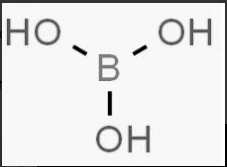
Generate a complete, print-ready paper with questions like this in minutes — across 16+ boards, with answer keys.
$SO{{_{3}^{2-}}_{\left( aq. \right)}}+{{H}_{2}}{{O}_{\left( l \right)}}\to SO{{_{4}^{2-}}_{\left( aq. \right)}}+2{{H}^{+}}_{\left( aq. \right)}+2{{H}^{+}}_{\left( aq. \right)}+2{{e}^{-}}$
If the oxidation number of metal in the salt was $+3$, what would be the new oxidation number of metal?
(Enthalpy of neutralisation $=57 \;kJ \;mol ^{-1}$ and Specific heat of water $=4.2\; JK ^{-1} g ^{-1}$ ) (Neglect heat capacity of flask)
$Cr _{2} O _{7}^{2-}+14 H ^{+}+6 e ^{-} \rightarrow 2 Cr ^{3+}+7 H _{2} O$
The amount of $Cr ^{3+}$ obtained was $0.104\, g$. The
efficiency of the process(in\%) is
(Take : $F =96000\, C$, At. mass of chromium $=52$ )