Question
$\mathrm{BCl}_3$ exists as monomer whereas $\mathrm{AlCl}_3$ is dimerised through halogen bridging. Give reason. Explain the structure of the dimer of $\mathrm{AlCl}_3$ also.
Answer

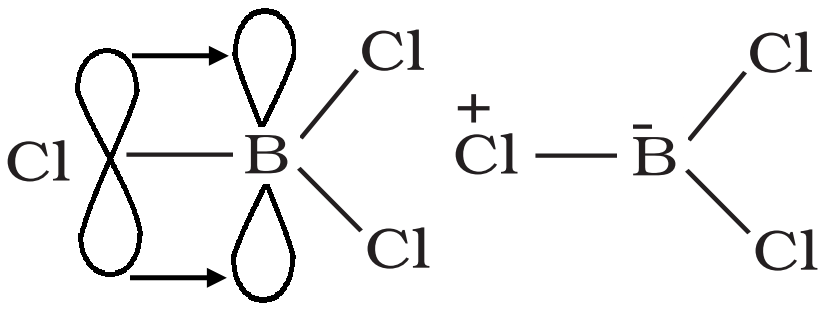
$\mathrm{BCl}_3$ exists as monomer in spite of the fact that it is an electron deficient compound. It achieves stability by forming $p \pi$ - $\mathrm{p} \pi$ back bonding. Chlorine transfers two electrons to vacant $2 p$-orbital of boron. All the three bond lengths are same. Thus, the back

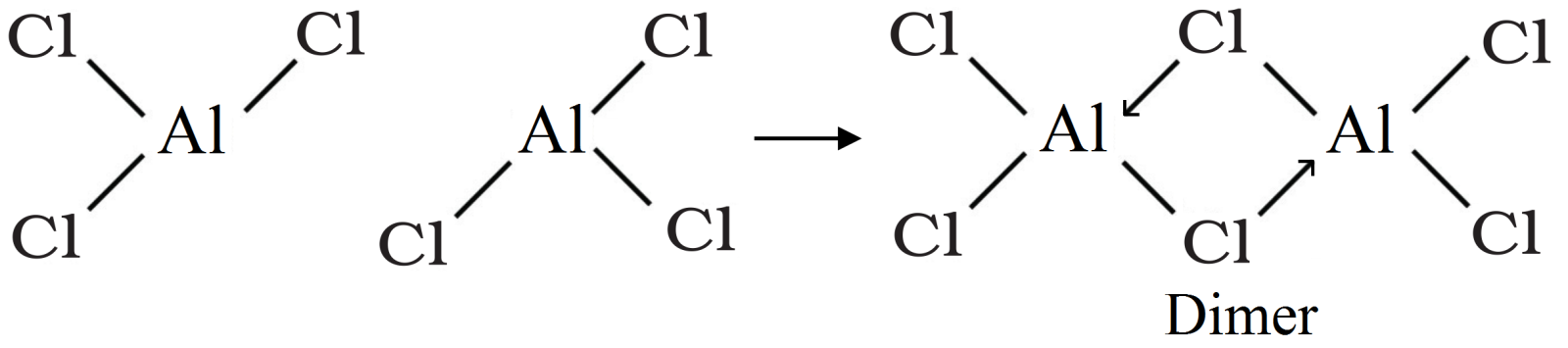
bonding giving double bond character is delocalized in the molecule. $\mathrm{AlCl}_3$ is also an electron deficient compound. Since, aluminium has larger size than boron, the back bonding is not possible in $\mathrm{AlCl}_3$. Aluminium metal complete its octet by forming coordinate bond with chlorine atom of the other molecule, $\mathrm{AlCl}_3$. Thus, coordinate bond forming bridges by chlorine atoms between two Al atoms make a dimer molecule.

Need a full question paper?

Generate a complete, print-ready paper with questions like this in minutes — across 16+ boards, with answer keys.

Start Generating Free

Similar questions

Explain briefly about the electrochemical series and give its main uses.
Ozone is a toxic gas and is a strong oxidising agent even then its presence in the stratosphere is very important. Explain what would happen if ozone from this region is completely removed?
 The ionization constant of $HF , HCOOH$ and HCN at 298 K are $6.8 \times 10^{-4}, 1.8 \times 10-4$ and $4.8 \times 10^{-9}$ respectively. Calculate the ionization constants of the corresponding conjugate base.
What will be the minimum pressure required to compress $500 \mathrm{dm}^3$ of air at 1 bar to $200 \mathrm{dm}^3$ at $30^{\circ} \mathrm{C}$ ?
First member of each group of representative elements (i.e., s and p-block elements) shows anomalous behaviour. Illustrate with two examples.
Calculate the pH of a solution formed by mixing equal volumes of two solutions A and B of a strong acid having pH = 6 and pH = 4 respectively.
In a system compressing of A, B, C
$\text{A}(\text{s})\rightleftharpoons2\text{B}(\text{g})+3\text{C}(\text{g})$
It conc. of 'C' is increased by factor of 2, what will be the equilibrium concentration of 'B' with respect to its original value.
What is the maximum concentration of equimolar solutions of ferrous sulphate and sodium sulphide so that when mixed in equal volumes, there is no precipitation of iron sulphide? (For iron sulphide, $K_{sp} = 6.3 \times 10^{–18}$).
  1. A sample of salt has the following percentage composition
Fe = 36.76%, S = 21.11 % and O = 42.14%
Calculate the empirical formula of the compound
  1. What happens if the compound is heated? Write the balanced chemical equation.
Define following.
(i) Molarity
(ii) Molality
(iii) Normality
(iv) Formality