MCQ
$\begin{array}{*{20}{c}}
  {OH\,\,\,\,\,\,\,\,\,\,\,\,\,\,\,\,\,\,\,\,\,\,\,\,\,\,} \\ 
  {|\,\,\,\,\,\,\,\,\,\,\,\,\,\,\,\,\,\,\,\,\,\,\,\,\,\,\,\,\,\,\,} \\ 
  {Ph - CH - C{H_3}\xrightarrow{{PCC}}(A)} 
\end{array}\xrightarrow{{\begin{array}{*{20}{c}}
  {\,\,\,\,\,\,\,\,\,\,\,\,\,O} \\ 
  {\,\,\,\,\,\,\,\,\,\,\,\,\,||} \\ 
  {N{H_2} - NH - C - N{H_2}} 
\end{array}}}(B)$

Product $(B)$ is

  • A
    $\begin{array}{*{20}{c}}
      {C{H_3}\,\,\,\,\,\,\,\,\,\,\,\,\,\,O\,\,\,\,\,\,\,\,\,\,\,\,\,\,\,\,\,\,\,\,\,} \\ 
      {|\,\,\,\,\,\,\,\,\,\,\,\,\,\,\,\,\,\,\,\,\,\,\,||\,\,\,\,\,\,\,\,\,\,\,\,\,\,\,\,\,\,\,\,} \\ 
      {Ph - C = N - C - NH - N{H_2}} 
    \end{array}$
  • $\begin{array}{*{20}{c}}
      {\,\,\,O} \\ 
      {\,\,\,||} \\ 
      {Ph - C = N - C - NH - N{H_2}} \\ 
      {|\,\,\,\,\,\,\,\,\,\,\,\,\,\,\,\,\,\,\,\,\,\,\,\,\,\,\,\,\,\,\,\,\,\,\,\,\,\,\,\,\,\,\,\,\,\,\,\,\,} \\ 
      {C{H_3}\,\,\,\,\,\,\,\,\,\,\,\,\,\,\,\,\,\,\,\,\,\,\,\,\,\,\,\,\,\,\,\,\,\,\,\,\,\,\,\,\,\,\,\,} 
    \end{array}$
  • C
    $\begin{array}{*{20}{c}}
      {\,\,\,\,\,\,\,\,\,\,\,\,\,\,\,\,\,\,\,\,\,\,\,\,\,\,\,\,\,\,\,\,\,\,\,\,\,\,\,O} \\ 
      {\,\,\,\,\,\,\,\,\,\,\,\,\,\,\,\,\,\,\,\,\,\,\,\,\,\,\,\,\,\,\,\,\,\,\,\,\,\,\,\,||} \\ 
      {Ph - CH = N - N - C - N{H_2}} \\ 
      {\,\,\,\,\,\,\,\,\,\,\,|} \\ 
      {\,\,\,\,\,\,\,\,\,\,\,\,\,\,\,\,C{H_3}} 
    \end{array}$
  • D
    $\begin{array}{*{20}{c}}
      {\,\,\,\,\,\,\,\,\,\,\,\,\,\,\,\,\,\,\,\,\,\,\,\,\,O} \\ 
      {\,\,\,\,\,\,\,\,\,\,\,\,\,\,\,\,\,\,\,\,\,\,\,\,\,\,||} \\ 
      {Ph - CH = N - C - N{H_2}} 
    \end{array}$
Answer

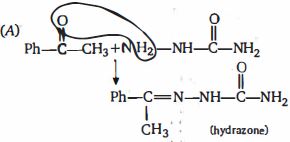
Correct option: B.
$\begin{array}{*{20}{c}}
  {\,\,\,O} \\ 
  {\,\,\,||} \\ 
  {Ph - C = N - C - NH - N{H_2}} \\ 
  {|\,\,\,\,\,\,\,\,\,\,\,\,\,\,\,\,\,\,\,\,\,\,\,\,\,\,\,\,\,\,\,\,\,\,\,\,\,\,\,\,\,\,\,\,\,\,\,\,\,} \\ 
  {C{H_3}\,\,\,\,\,\,\,\,\,\,\,\,\,\,\,\,\,\,\,\,\,\,\,\,\,\,\,\,\,\,\,\,\,\,\,\,\,\,\,\,\,\,\,\,} 
\end{array}$
b

Need a full question paper?

Generate a complete, print-ready paper with questions like this in minutes — across 16+ boards, with answer keys.

Start Generating Free

Similar questions

Select the gas-phase reaction$(s)$ which can proceed spontaneously ?
Arrange the compounds in order of decreasing reactivity for nucleophilic additon reaction

$\mathop {\begin{array}{*{20}{c}}
  {O\,\,\,\,\,\,\,\,\,\,\,\,\,} \\ 
  {||\,\,\,\,\,\,\,\,\,\,\,\,} \\ 
  {C{H_3} - C - C{H_2} - Cl} 
\end{array}}\limits_{\left( I \right)} $    $\underset{(II)}{\mathop{\begin{matrix}
   \,\,\,\,\,\,\,\,\,\,\,\,\,\,\,\,\,\,O  \\
   \,\,\,\,\,\,\,\,\,\,\,\,\,\,\,\,\,\,\,\,\,||\,\,\,  \\
   Cl-C{{H}_{2}}-C-H  \\
\end{matrix}}}\,$

$\mathop {\begin{array}{*{20}{c}}
  O \\ 
  {||} \\ 
  {H - C - H} 
\end{array}}\limits_{\left( {III} \right)} $    $\mathop {\begin{array}{*{20}{c}}
  O \\ 
  {||} \\ 
  {{H_3}C - C - C{H_3}} 
\end{array}}\limits_{\left( {IV} \right)} $

Identify $A$ and $B$ in the chemical reaction.
$P_4O_{10}$ has short and long $P-O$ bonds. The number of short $(P-O)$ bonds in this compound
Vitamin $B_1$ is:
Which of the following compound does not give Tollen’s test?
Which of the following chemical contains chlorine
Product $(A)$ is
Rank the transition states that occur during the following reaction steps in order of
increasing stability (least $\to$ most stable)
$1. {{H}_{3}}C-\overset{+}{\mathop{O}}\,{{H}_{2}}\to CH_{3}^{+}+{{H}_{2}}O$
$2. (CH_3)_3 C - \overset{+}{\mathop{O}}\,{{H}_{2}} \to (CH_3)_3 C^+ + H_2O$
$3. (CH_3 )_2CH - \overset{+}{\mathop{O}}\,{{H}_{2}} \to (CH_3)_2 CH^+ + H_2O$
Which has the lowest boiling point at $\text{1 atm}$ pressure?