MCQ
Benedict solution provides
  • A
    $A{g^ + }$
  • B
    $L{i^ + }$
  • $C{u^{ + 2}}$
  • D
    $B{a^{ + 2}}$

Answer

Correct option: C.
$C{u^{ + 2}}$
c
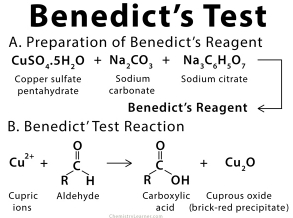
Benedict's solution is used to test for reducing sugars (free aldehyde group). The aldehyde gets oxidised and in the process, reduces the $Cu ^{+}$found in the complex provided by Benedict solution to form copper$(I)$ oxide, $Cu _2 O$.

Need a full question paper?

Generate a complete, print-ready paper with questions like this in minutes — across 16+ boards, with answer keys.

Start Generating Free

Similar questions

Of the different allotropes of phosphorus, the one which is most reactive is
$\begin{array}{*{20}{c}}
  {C{H_3} - C - C{H_2} - C - O - C{H_3}} \\ 
  \,\,{||\,\,\,\,\,\,\,\,\,\,\,\,\,\,\,\,\,\,\,\,\,\,\,\,\,\,\,\,||\,\,\,\,\,\,\,\,\,\,\,\,\,\,\,} \\ 
  {O\,\,\,\,\,\,\,\,\,\,\,\,\,\,\,\,\,\,\,\,\,\,\,\,\,\,O\,\,\,\,\,\,\,\,\,\,\,} 
\end{array}$ $\xrightarrow[{{H^ \oplus }}]{{{H_2}O}}A\xrightarrow{\Delta }B\xrightarrow{{HCN}}C$ 

what is $'B'$ and $'C'$

Acetylsalicylic acid is a pain killer and is commonly known as:
The ring deuteration of phenol
The correct statement with respect to dinitrogen is
$IUPAC$  name of $\left[ {Pt{{(N{H_3})}_3}(Br)(N{O_2})Cl} \right]Cl$ is
The more negative the standard potential, the .............. is its ability to displace hydrogen from acids.
The half-life of a first order reaction $X \to Y$ , is $100\,\min$. The concentration of $X$ would be reduced to $10\%$ of the initial concentration in .......... $\min$
In which case Raoult's law is not applicable
For the following reaction

$2 X + Y \xrightarrow{i} P$

the rate of reaction is $\frac{ d [ P ]}{ dt }=k[ X ]$. Two moles of $X$ are mixed with one mole of $Y$ to make $1.0 L$ of solution. At $50 s , 0.5$ mole of $Y$ is left in the reaction mixture. The correct statement(s) about the reaction is(are)

(Use: $\ln 2=0.693$ )

$(A)$ The rate constant, $k$, of the reaction is $13.86 \times 10^{-4} s ^{-1}$.

$(B)$ Half-life of $X$ is $50 s$.

$(C)$ At $50 s ,-\frac{ d [ X ]}{ dt }=13.86 \times 10^{-3} mol L ^{-1} s ^{-1}$.

$(D)$ At $100 s ,-\frac{ d [ Y ]}{ dt }=3.46 \times 10^{-3} mol L ^{-1} s ^{-1}$.