MCQ
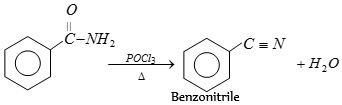
Benzamide on reaction with $POC{l_3}$ gives
  • A
    Aniline
  • B
    Chlorobenzene
  • C
    Benzyl amine
  • Benzonitrile

Answer

Correct option: D.
Benzonitrile
d
(d)

Need a full question paper?

Generate a complete, print-ready paper with questions like this in minutes — across 16+ boards, with answer keys.

Start Generating Free

Similar questions

From the following ${E^o}$ values of half cells, what combination of two half cells would result in a cell with the largest potential ?

$\left( I \right)A + {e^ - } \to {A^\circleddash  }\,\,\,\,\,\,{E^o} =  + 0.24\,V$

$\left( {II} \right){B^ - } + {e^ - } \to {B^{ - 2}}\,\,\,\,\,\,{E^o} =  + 1.25\,V$

$\left( {III} \right){C^ - } + 2{e^ - } \to {C^{ - 3}}\,\,\,\,\,\,{E^o} =  + 0.15\,V$

$\left( {IV} \right)D + 2{e^ - } \to {D^{ - 2}}\,\,\,\,\,\,{E^o} =  + 0.68\,V$
In the following reaction : $xA \to  yB$ $\log \left[ { - \frac{{d\left[ A \right]}}{{dt}}} \right] = \log \left[ {\frac{{d\left[ B \right]}}{{dt}}} \right] + \log \,2$ where $-ve$ sign indicates rate of disappearance of the reactant. Thus, $x : y$ is
Which one of the following orders is correct for the bond dissociation enthalpy of halogen molecules ?
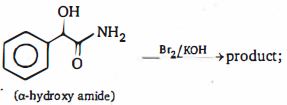
Product of this Hoffmann bromamide reaction is
During an electrolysis of conc. $H_2SO_4$ , perdisulphuric acid $(H_2S_2O_8)$ and $O_2$ form in equimolar amount. The amount of $H_2$ that will form simultaneously will be $(2{H_2}S{O_4} \to {H_2}{S_2}{O_8} + 2{H^ + } + 2{e^ - })$
Which of the comparison regarding $Zn,\,Cd,\,Hg$ is/are incorrect ?

$(I)$ $ZnCl_2$ is ionic whereas $CdCl_2$ and $HgCl_2$ are covalent

$(II)$ $Zn$ and $Cd$ dissolves in dilute acid $(HCl)$ liberating $H_2$ but $Hg$ can not

$(III)$ $Zn$ and $Cd$ forming with ppt. of $Zn(OH)_2$ and $Cd(OH)_2$ but $Hg$ forms coloured ppt. of

$(IV)$ all from $A_2^{2+}$ type ion

Rate constant of a reaction is given as 

${\log _{10}}K =  - \frac{{2000}}{T} + 6.0$ Activation energy is ....... $kcal$
The noble gas compound prepared by bartlett was
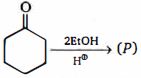
Product $(P)$ is 
Differentiating electron in inner transition elements enters the $.......$ orbital.