MCQ
Benzamide react with $Br_2$ and $KOH$ gives :-
- ABenzene
- BBromobenzene
- CAniline
- ✓Benzylamine
Generate a complete, print-ready paper with questions like this in minutes — across 16+ boards, with answer keys.
$\mathrm{A}+\mathrm{B} \rightarrow \mathrm{C}$
$\text { rate }=\mathrm{k}[\mathrm{A}]^{1 / 2}[\mathrm{~B}]^{1 / 2}$
The reaction is initiated by taking $1 \mathrm{M}$ concentration $A$ and $B$ each. If the rate constant $(k)$ is $4.6 \times 10^{-2} \mathrm{~s}^{-1}$, then the time taken for $\mathrm{A}$ to become $0.1 \mathrm{M}$ is . . . . . . . . . . sec. (nearest integer)
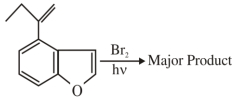
Which forms di-iodide on reaction with $HI $ (excess) ?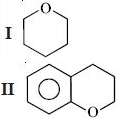
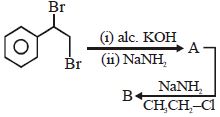
$(x)\begin{array}{*{20}{c}}
{O\,\,\,}\\
{||\,\,\,}\\
{C{H_3} - S - O - H}\\
{||\,\,\,\,}\\
{O\,\,\,\,}
\end{array}$
$\begin{array}{*{20}{c}}
{\,\,\,\,\,O}\\
{\,\,\,\,\,\,||}\\
{(y)\,\,\,C{H_3} - C - O - H}
\end{array}$
$(z)\,\, CH_3 -OH$
${{C}_{2}}{{H}_{5}}N{{H}_{2}} \xrightarrow{HN{{O}_{2}}}A \xrightarrow{PC{{l}_{5}}}B \xrightarrow{H.N{{H}_{2}}}C$