MCQ
Benzene can be obtained in the reaction
  • A
    Ethene $+ 1, 3-$butadiene
  • Trimerisation of ethyne
  • C
    Reduction of $PhCHO$
  • D
    All of these

Answer

Correct option: B.
Trimerisation of ethyne
b
(b) Benzene can be obtained by polymerisation of acetylene.

Need a full question paper?

Generate a complete, print-ready paper with questions like this in minutes — across 16+ boards, with answer keys.

Start Generating Free

Similar questions

What is the conjugate acid of $HPO_4^{2-}$ ?
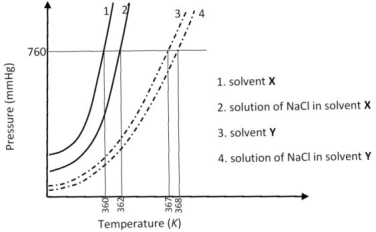
The plot given below shows $P - T$ curves (where $P$ is the pressure and $T$ is the temperature) for two solvents $X$ and $Y$ and isomolal solutions of $NaCl$ in these solvents. $NaCl$ completely dissociates in both the solvents.

On addition of equal number of moles of a non-volatile solute $S$ in equal amount (in $kg$ ) of these solvents, the elevation of boiling point of solvent $X$ is three times that of solvent $Y$. Solute $S$ is known to undergo dimerization in these solvents. If the degree of dimerization is $0.7$ in solvent $Y$, the degree of dimerization in solvent $X$ is. . . . . . .

What sequence of reagents is required to accomplish the following transformation ?
Percentage of $s-$character in $s{p^3}$ hybrid orbital is
Which amino acid does not contain chiral centre ?
From amongst the following alcohols the one that would react fastest with conc. $HCl$ and anhydrous $ZnCl_2,$ is
The standard electrode potentials

${E^o}_{\left( {{I_2}/{I^ - }} \right)},{E^ \circ }_{\left( {Br^-/B{r_2}} \right)}$ and ${E^ o }_{\left( {{Fe}/{Fe^{2+} }} \right)}$

are respectively $+ 0.54\  V$, $-1.09\  V$ and $0.44\  V$. On the basis of above data which of the following process is non-spontaneous
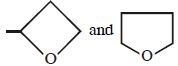
Given two compounds are ............. 
How many atoms of calcium will be deposited from a solution of $CaC{l_2}$ by a current of $25$  milliamperes flowing for $60$  seconds
The energy of an electron in the first Bohr’s orbit of $H$ atom is $-13.6\,eV.$ The possible energy value (s) of the excited state (s) for electron in Bohr’s orbits of hydrogen is (are) : ............. $\mathrm{eV}$