MCQ
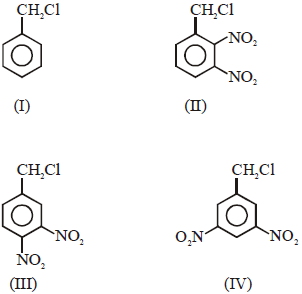
Benzene can react with
- A$B{r_2}$ water
- ✓$HN{O_3}$
- C${H_2}O$
- D$C{H_3}OH$
$B.$ Benzene reacts with concentrated nitric acid at $323-333\, k$ in the presence of concentrated sulphuric acid to form nitrobenzene. This reaction is known as nitration of benzene
$C.$ Benzene is nonpolar and water is highly polar. If we add benzene to water, benzene will float on the top of the water with no apparent mixing.
$D.$ The alkylation reaction of benzene with methanol to produce toluene: $Y - C$ and $Y - C _{ cs }$ catalyst. The secondary reaction of toluene is difficult to be suppressed in benzene alkylation with methanol over conventional acidic zeolite catalysts. Moreover, the formation of coke yet remains a challenging problem.
Therefore on seen the all above option, we find $NO _3$ is best Suitable option.
Generate a complete, print-ready paper with questions like this in minutes — across 16+ boards, with answer keys.
| Test | $C$ | $D$ |
| Ceric ammonium nitrate Test | Positive | positive |
| Lucas Test | Turbidity obtained after five minutes | Turbidity obtained immediately |
| Iodoform Test | Positive | Negative |
$C$ and $D$ respectively are
$(I)$ Low enthalpy of dissociation of $F-F$ bond
$(II)$ High hydration enthalpy of $F^-$
$(III)$ Low atomisation enthalpy of $F_2$

|
List$-I$ (Metal Ion) |
List$-II$ (Group in Qualitative analysis) |
| $(a)$ ${Mn}^{2+}$ | $(i)$ Group $- III$ |
| $(b)$ ${A} {s}^{3+}$ | $(ii)$ Group $- IIA$ |
| $(c)$ ${Cu}^{2+}$ | $(iii)$ Group $- IV$ |
| $(d)$ ${Al}^{3+}$ | $(iv)$ Group $- IIB$ |
Choose the most appropriate answer from the options given below :