MCQ
Benzene cannot undergo
- ASubstitution
- BAddition
- ✓Elimination
- DOxidation
Benzene can undergo addition reaction. Example : Bromo-Benzene
Benzene can oxidise to Phenol, Catechol, etc
So the culprit is Elimination reaction.
Benzene cannot undergo Elimination reaction.
Generate a complete, print-ready paper with questions like this in minutes — across 16+ boards, with answer keys.
$1.$ The compound ${X}$ is
$(A)$ $\mathrm{NaNO}_3$ $(B)$ $\mathrm{NaCl}$ $(C)$ $\mathrm{Na}_2 \mathrm{SO}_4$ $(D)$ $\mathrm{Na}_2 \mathrm{~S}$
$2.$ The compound ${Y}$ is
$(A)$ $\mathrm{MgCl}_2$ $(B)$ $\mathrm{FeCl}_2$ $(C)$ $\mathrm{FeCl}_3$ $(D)$ $\mathrm{ZnCl}_2$
$3.$ The compound ${Z}$ is
$(A)$ $\left.\mathrm{Mg}_2 \mid \mathrm{Fe}(\mathrm{CN})_6\right]$ $(B)$ $\operatorname{Fe}\left[\mathrm{Fe}(\mathrm{CN})_6\right]$
$(C)$ $\mathrm{Fe}_4\left[\mathrm{Fe}(\mathrm{CN})_6\right]_3$ $(D)$ $\mathrm{K}_2 \mathrm{Zn}_3\left[\mathrm{Fe}(\mathrm{CN})_6\right]_2$
Give the answer question $1,2$ and $3.$
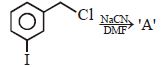
If molar mass of hydrochloric acid is $M.$
$\begin{matrix}
O\,\,\,\,\,\,\,\,\,\,\,\,\,\,\,\,\,\,\,\,\,\,\,\,\,\,\,\,\,\,\,\,\,\,\,\,\,\, \\
||\,\,\,\,\,\,\,\,\,\,\,\,\,\,\,\,\,\,\,\,\,\,\,\,\,\,\,\,\,\,\,\,\,\,\,\,\,\,\,\, \\
C{{F}_{3}}\,C\,OH+C{{H}_{3}}\,CH\,C{{H}_{3}} \\
\,\,\,\,\,\,\,\,\,\,\,\,\,\,\,\,\,\,\,\,\,\,\,\,\,\,\,\,\,\,| \\
\,\,\,\,\,\,\,\,\,\,\,\,\,\,\,\,\,\,\,\,\,\,\,\,\,\,\,\,\,\,\,\,\,OH \\
\end{matrix}\xrightarrow{{{H}_{2}}S{{O}_{4}}}\begin{matrix}
O\,\,\,\,\,\,\,\,\,\,\,\,\,\,\,\,\,\,\,\,\,\,\,\,\,\,\,\,\,\,\, \\
||\,\,\,\,\,\,\,\,\,\,\,\,\,\,\,\,\,\,\,\,\,\,\,\,\,\,\,\,\,\,\,\,\, \\
C{{F}_{3}}\,C\,OCH\,C{{H}_{3}}+{{H}_{2}}O \\
|\,\,\,\,\,\,\,\,\,\,\,\, \,\,\,\, \\
C{{H}_{3}}\,\,\,\,\,\,\,\,\,\,\, \\
\end{matrix}$