MCQ
Benzene shows
- ASubstitution
- BAddition
- COxidation
- ✓All of these
Benzene resists addition reactions because that would involve breaking the delocalisation and losing that stability.
An alkylbenzene is simply a benzene ring with an alkyl group attached to it. ... Alkyl groups are usually fairly resistant to oxidation. However, when they are attached to a benzene ring, they are easily oxidised by an alkaline solution of potassium manganate($VII$) (potassium permanganate).
Generate a complete, print-ready paper with questions like this in minutes — across 16+ boards, with answer keys.
${A_{2\left( g \right)}} \longrightarrow {B_{\left( g \right)}} + \frac{1}{2}\,{C_{\left( g \right)}}$ the increase in pressure from $100\, mm$ to $120\, mm$ is noticed in $5\,\min$. The rate of dissappearence of $A_2$ in $mm\, min^{-1}$ is
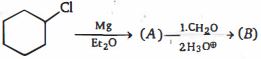
(Atomic numbers $Ce =58, Gd =64$ and $Eu =63 .)$
$(a)$ $\left( NH _{4}\right)_{2}\left[ Ce \left( NO _{3}\right)_{6}\right]$
$(b)$ $Gd \left( NO _{3}\right)_{3}$ and
$(c)$ $Eu \left( NO _{3}\right)_{3}$
Answer is :