MCQ
Best reagent to carry out following conversion is
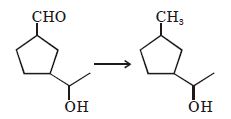
  • A
    Red $P / I_2$
  • B
    $LiAlH_4$ , $Et_2O$
  • C
    $Zn-Hg / HCl$
  • $(i)$ $N_2H_4$ ; $(ii)$ $\mathop O\limits^\Theta  H ,\Delta $

Answer

Correct option: D.
$(i)$ $N_2H_4$ ; $(ii)$ $\mathop O\limits^\Theta  H ,\Delta $
d

Need a full question paper?

Generate a complete, print-ready paper with questions like this in minutes — across 16+ boards, with answer keys.

Start Generating Free

Similar questions

Acompound of mercury used in cosmetics, in Ayurvedic and Yunani medicines and known as Vermilon is
$CH_3CHI_2$ $\overset{KCN}{\rightarrow}$ $\xrightarrow[\Delta]{H_3O^+ }$ ? Here the end product would be 
Formation for ammonia is shown by the reaction ${N_{2(g)}} + 3{H_{2(g)}} \to 2N{H_{3(g)}},{\Delta _r}{H^o} =  - 91.8\,kJ\,mo{l^{ - 1}}$ What will be the enthalpy of reaction for the decomposition of $NH_3$ according to the reaction $2N{H_{3(g)}} \to {N_{2(g)}} + 3{H_2};{\Delta _r}{H^o} = ?$ .....$ kJ\, mol^{-1}$
Assertion : $\Delta H$ and $\Delta E$ are almost same for the reaction $N_2 (g) + O_2 (g)  \rightleftharpoons  2NO(g)$
Reason : All reactants and products are gases.
$AB, A_2$ and $B_2$ are diatomic molecules. If the bond enthalpies of $A_2, AB$ and $B_2$ are in the ratio $1:1 : 0.5$ and enthalpy of formation of $AB$ from $A_2$ and $B_2$ is $-100\, kJ\, mol^{-1}$ . What is the bond energy of $A_2$ .............. $\mathrm{kJ\,mol}^{-1}$
$KMn{O_4}$ reacts with oxalic acid according to the equation, $2MnO_4^ - + 5{C_2}O_4^{2 - } + 16{H^ + } \to 2M{n^{2 + }} + 10C{O_2} + 8{H_2}O$, here $20\, ml$ of $ 0.1\, M$ $KMn{O_4}$ is equivalent to
The molecular formula of second homologue in the homologous series of mono carboxylic acids is _______________ .
The surface of copper gets tarnished by the formation of copper oxide. $N _2$ gas was passed to prevent the oxide formation during heating of copper at $1250 K$. However, the $N _2$ gas contains $1$ mole $\%$ of water vapour as impurity. The water vapour oxidises copper as per the reaction given below:$2 Cu ( s )+ H _2 O ( g ) \longrightarrow Cu _2 O ( s )+ H _2( g )$
$P _{ H _2}$ is the minimum partial pressure of $H _2$ (in bar) needed to prevent the oxidation at $1250 K$.
The value of $\ln \left( p _{ H _2}\right)$ is $. . . . .$
(Given: total pressure $=1$ bar, $R ($universal gas constant$) =8 JK ^{-1} mol ^{-1}, \ln (10)=2.3$.
$Cu ( s )$ and $Cu _2 O ( s )$ are mutually immiscible.
At $1250 K : 2 Cu ( s )+1 / 2 O _2( g ) \longrightarrow Cu _2 O ( s ) ; \Delta G ^\theta=-78,000 J mol ^{-1}$
$H _2( g )+1 / 2 O _2( g ) \longrightarrow H _2 O ( g ) ; \Delta G ^\theta=-1,78,000 J mol ^{-1} ; G$ is the Gibbs energy$)$
The $IUPAC$  name of $\begin{matrix}
   C{{H}_{3}}-C-C-C{{H}_{3}}  \\
   ||\,\,\,\,\,\,\,\,||  \\
   O\,\,\,\,\,\,O  \\
\end{matrix}$ is
Identify the incorrect statement among the following