- AAlpha particle
- BPositron
- CNeutron
- DGamma ray
Explanation:
We know that a moving charged particle experiences a force in a magnetic force , as the given unknown particle is not affected by magnetic field , so it cannot be a charged particle.
But beta, alpha and positron are charged particle therefore they are not the unknown particle , only neutron is chargeless particle so it is the unknown particle.
Gamma rays are not particle though they are also not affected by a magnetic field.
Generate a complete, print-ready paper with questions like this in minutes — across 16+ boards, with answer keys.
When wavelength of incident photon is decreased then
|
(a) Velocity of emitted photo-electron decreases |
|
(b) Velocity of emitted photoelectron increases |
|
(c) Velocity of photoelectron do not charge |
|
(d) Photo electric current increases |
Energy in the sun is generated mainly by
|
(a) Fusion of radioactive material |
(b) Fission of helium atoms |
|
(c) Chemical reaction |
(d) Fusion of hydrogen atoms |
Faraday’s 2nd law states that mass deposited on the electrode is directly proportional to
|
(a) Atomic mass |
(b) Atomic mass × Velocity |
|
(c) Atomic mass/Valency |
(d) Valency |
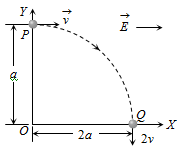
A particle of charge +q and mass m moving under the influence of a uniform electric field
and a uniform magnetic field
follows trajectory from P to Q as shown in figure. The velocities at P and Q are v
and -2v
respectively. Which of the following statement(s) is/are correct

|
(a) E = |
|
(b) Rate of work done by electric field at P is |
|
(c) Rate of work done by both the fields at Q is zero |
|
(d) a, b, c |
Demagnetisation of magnets can be done by
| (a) Rough handling | (b) Heating |
| (c) Magnetising in the opposite direction | (d) All the above |