MCQ
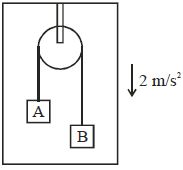
Block $A$ and $B$ of mass $2\,kg$ and $4\,kg$ are suspended through a string using a pulley, inside an elevator moving downward with constant acceleration $2\,m/s^2$. The tension in the string which is joining two blocks
  • $\frac{{64}}{3}N$
  • B
    $\frac{{32}}{3}N$
  • C
    $\frac{{8}}{3}N$
  • D
    $\frac{{16}}{3}N$

Answer

Correct option: A.
$\frac{{64}}{3}N$
a
$\mathrm{g}_{\mathrm{eff}}=\mathrm{g}-\mathrm{a}=10-2=8 \mathrm{m} / \mathrm{s}^{2}$

$\mathrm{T}=\frac{2 \mathrm{m}_{1} \mathrm{m}_{2}}{\mathrm{m}_{1}+\mathrm{m}_{2}} \mathrm{g}_{\mathrm{eff}}=\frac{2(2)(4)(8)}{6}=\frac{64}{3} \mathrm{N}$

Need a full question paper?

Generate a complete, print-ready paper with questions like this in minutes — across 16+ boards, with answer keys.

Start Generating Free

Similar questions

Find the amount of work done to increase the temperature of one mole of an ideal gas by $30^o\ C$ if it is expanding under the condition  .... $J$

$V\propto {T^{\frac{2}{3}}}$ $[R = 1.99\  cal/mol-K]$

A rod of mass $m$ and length $l$ is placed on smooth floor pivoted at its centre. A gun is mounted at one end, of mass $m$ without a shot. It fires a shot of mass $\frac{m}{{10}}$ with velocity $v$ relative to gun. The angular velocity of the rod will be
If the radius of a solid sphere is $35\,\,cm,$  calculate the radius of gyration when the axis is along a tangent
A tuning fork vibrating with a sonometer having $20 cm$ wire produces $5$ beats per second. The beat frequency does not change if the length of the wire is changed to $21 cm.$ the frequency of the tuning fork (in Hertz) must be
A screen is placed a distance 40cm away from an illuminated object. A converging lens is placed between the source and the screen and it is attempted to form the image of the source on the screen. If no position could be found, the focal length of the lens:
The standing wave in a medium is expressed as $y=0.2 \sin (0.8 x) \cos (3000 t) \,m$. The distance between any two consecutive points of minimum or maximum displacement is
A force $F$ acting on an object varies with distance $x$as shown here. The force is in newton and $x$ in metre. The work done by the force in moving the object from $x = 0$to $x = 6\,m$ is......$J$
On a frictionless horizontal plane, a bob of mass $m=0.1 kg$ is attached to a spring with natural length $l_0=0.1 m$. The spring constant is $k_1=0.009 Nm ^{-1}$ when the length of the spring $I > l_0$ and is $k_2=0.016 Nm ^{-1}$ when $ I < l_0$. Initially the bob is released from $l=0.15 m$. Assume that Hooke's law remains valid throughout the motion. If the time period of the full oscillation is $T=(n \pi) s$, then the integer closest to $n$ is. . . . .
If the change in the value of $‘g’$ at a height $h$ above the surface of the earth is the same as at a depth $x$ below it, then (both $x$ and $h$ being much smaller than the radius of the earth)
The $ P.E.$ of a particle executing $SHM$ at a distance $x$ from its equilibrium position is