MCQ
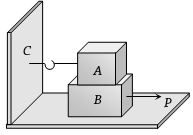
Block $A$ weighing $100$ kg rests on a block $B$ and is tied with a horizontal string to the wall at $C$. Block $B$ weighs $200 \,kg$. The coefficient of friction between $A$ and $B$ is $0.25$ and between $B$ and the surface is $1/3$. The horizontal force $P$ necessary to move the block $B$ should be  ........ $N$ $(g = 10\,m/{s^2})$
  • A
    $1150$
  • $1250$
  • C
    $1300$
  • D
    $1420$

Answer

Correct option: B.
$1250$
b
(b) Friction between block $A$ and block $B$ & between block $B$ and surface will oppose the $P$

$\therefore $ $P = {F_{AB}} + {F_{BS}}$ $ = {\mu _{AB}}{m_A}g + {\mu _{BS}}({m_A} + {m_B})g$

$ = 0.25 \times 100 \times 10 + \frac{1}{3}(100 + 200) \times 10$ $=1250\, N$

Need a full question paper?

Generate a complete, print-ready paper with questions like this in minutes — across 16+ boards, with answer keys.

Start Generating Free

Similar questions

One end of a uniform rod of mass $m$ and length $(l)$ is clamped. The rod lies on a smooth horizontal surface and rotates on it about the clamped end at a uniform angular velocity $\omega.$ The force exerted by the clamp on the rod has a horizontal component:
A balloon of mass $m$ contains water of mass $M$ . If it is completely immersed in water, find the apparent mass of the balloon with water in it
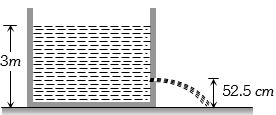
Water is filled in a cylindrical container to a height of $3m. $ The ratio of the cross-sectional area of the orifice and the beaker is $ 0.1. $ The square of the speed of the liquid coming out from the orifice is ....... $m^2/s^2$  ($g = 10 m/s^2$)
Two satellites $S _{1}$ and $S _{2}$ are revolving in circular orbits around a planet with radius $R _{1}=3200 \,km$ and $R _{2}=800\, km$ respectively. The ratio of speed of satellite $S_{1}$ to the speed of satellite $S_{2}$ in their respective orbits would be $\frac{1}{ x }$ where $x =$
Two stones are thrown up simultaneously with initial speeds of ' $u_1$ and $u_2\left(u_2 > u_1\right)$. They hit the ground after $6\,s$ and $10\,s$ respectively. Which graph in figure correctly represents the time variation of $\Delta x=\left(x_2-x_1\right)$, the relative position of the second stone with respect to the first upto $t=10\,s$ ? Assume that the stones do not rebound after hitting the ground.
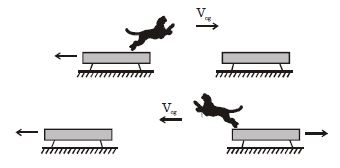
A strange cat with a mass $m_c$ is sitting at rest on the left plank of a pair of identical planks. Each plank has mass $m_s$ and they rest on frictionless ice. Suddenly, the cat leaps to the right plank, traveling with a horizontal speed $v_{cg}$ measured with respect to the ground. The instant the cat reaches the right plank, it turns around and leaps back to the left plank. The horizontal component of the cat’s speed is again $v_{cg}$ measured with respect to the ground. The final speed of right plank in terms of the masses of the cat and planks and the cat’s leaping speed is (The cat remains on the left plank after its return).
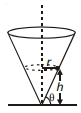
A particle describes a horizontal circle of radius $r$ on the smooth surface of an inverted cone as shown. The height of plane of circle above vertex is $h$. The speed of particle should be
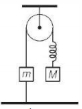
An arrangement of spring, strings, pulley and masses is shown in the figure below.The pulley and the strings are massless and $M>m$. The spring is light with spring constant $k$. If the string connecting $m$ to the ground is detached, then immediately after detachment
For a satellite escape velocity is $11\, km/s$. If the satellite is launched at an angle of $60^°$ with the vertical, then escape velocity will be ........... $km/s$
If $|\vec A \times \vec B| = \sqrt 3 \vec A.\vec B,$ then the value of$|\vec A + \vec B|$ is