Question
Bond angle in NH3 is more than in H2O. Justify.
Answer

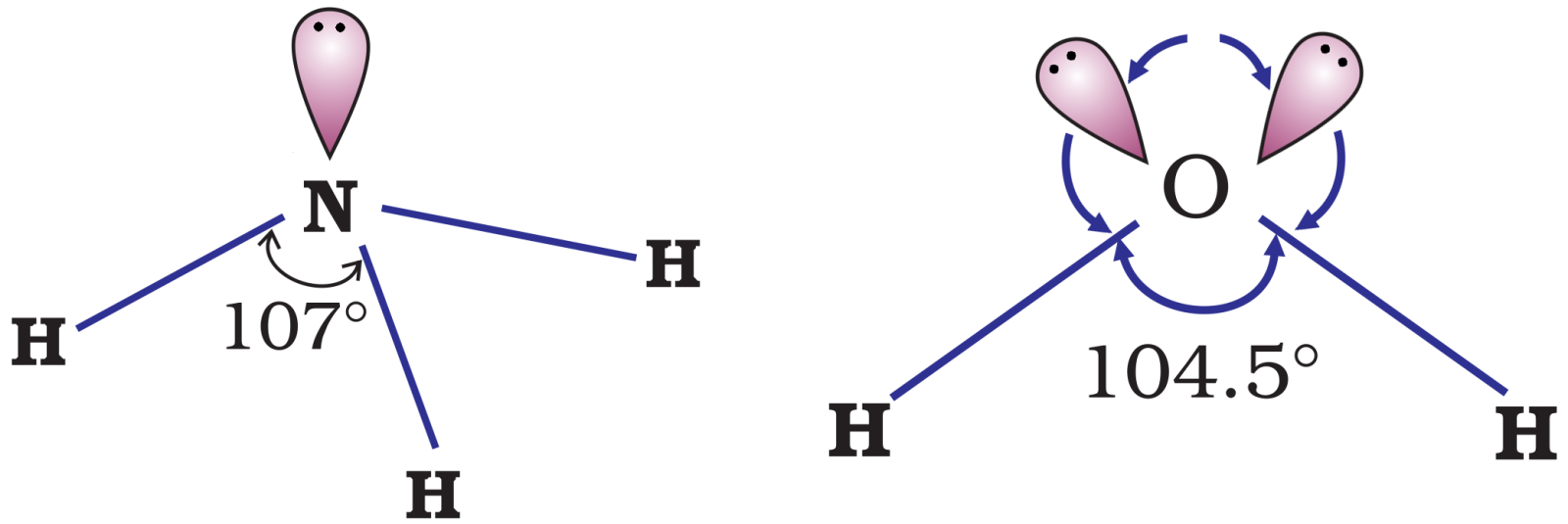
Both NH3 and H2O are sp3 hybridised but there is only one lone pair present on N in NH3 and two lone pairs on O of H2O. Since lone pair-lone pair repulsion is greater than lone pair-bond pair and bond pair-bond pair repulsions, two lone pairs on oxygen push the bond pairs more closer than one lone pair on nitrogen. This leads to smaller bond angle in H2O than in NH3.

Need a full question paper?

Generate a complete, print-ready paper with questions like this in minutes — across 16+ boards, with answer keys.

Start Generating Free

Similar questions

Find the oxidation state of sulphur in the following compounds:
$\text{H}_2\text{S},$
$\text{H}_2\text{SO}_4,$
$\text{S}_2\text{O}_4^{2-}$
$\text{S}_2\text{O}_8^{2-}$
$\text{HSO}_3^-$
  1. Why is Wurtz reaction is carried out in dry ether?
  2. Why do alkene have higher boiling point than alkane?
The first $(\Delta_{1}\text{H}_{1})$ and the second $(\Delta_{1}\text{H}_{1})$ ionization enthalpies (in kJ mol–1) and the $(\Delta_{1}\text{H}_{1})$ electron gain enthalpy (in kJ mol–1) of a few elements are given below:
Elements $\Delta\text{H}_{1}$ $\Delta{\text{H}}_{2}$ $\Delta_{\text{eg}}\text{H}$
I 520 7300 -60
II 419 3051 -48
III 1681 3374 -328
IV 1008 1846 -295
V 2372 5251 +48
VI 738 1451 -40
Which of the above elements is likely to be:
The metal which can form a stable binary halide of the formula MX2(X=halogen).
Use the periodic table to answer the following questions.
Identify an element with five electrons in the outer subshell.
The threshold frequency v, for a metal is 7.0 × 10¹⁴s-1. Calculate the kinetic energy of an electron emitted when radiation of v = 1.0 × 10¹⁵s-1 hits the metal.
Which of the following are isoelectronic species i.e., those having the same number of electrons?
$
Na^{+}, K^{+}, Mg^{2+}, Ca^{2+}, S^{2-}, Ar
$
Define mole.
Calculate number of ions in 3 mole $Al _2\left( SO _4\right)_3$
Predict the periods and blocks to which each of the following elements belong?
  1. 13Al
  2. 24Cr
  3. 29Cu
  4. 11Na
Use the following data to calculate the Ksp value for Agl(s)

$\text{H}_{2}\text{(g)} + \text{Cl}_{2} \text{(g)} \rightleftharpoons\text{2HCl(g)}$

$\Delta\text{H}^{\circ} = -92\text{kJ}, \ \Delta\text{S}^{\circ} = -95\text{JK}^{-1}$