MCQ
Bond-breaking is an _________________process.
- AEndothermic
- BExothermic
- CNeither exothermic nor endothermic.
- DEither exothermic or endothermic.
Generate a complete, print-ready paper with questions like this in minutes — across 16+ boards, with answer keys.
$PC{l_5}\, \rightleftharpoons \,PC{l_3}\, + \,C{l_2}\,;\,{K_C} = \,0.0414\,mol\,{L^{ - 1}}$
${C_6}{H_5}(l)\, + \,\frac{{15}}{2}\,{O_2}(g)\, \to \,6\,C{O_2}(g)\, + \,3{H_2}O\,(l);$ $\Delta H = \,-\,3271\,kJ$
What is $\Delta U$ for the combustion of $1.5\,mole$ of benzene at $27\,^oC$ ? .....$kJ$
If $T _2> T _1$, the correct statement(s) is (are)
(Assume $\Delta H ^{\ominus}$ and $\Delta S ^{\ominus}$ are independent of temperature and ratio of $\ln K$ at $T _1$ to $\ln K$ at $T_2$ is greater than $T_2 / T_1$. Here $H, S, G$ and $K$ are enthalpy, entropy, Gibbs energy and equillibrium constant, respectively.)
$(A)$ $\Delta H ^{\ominus}<0, \Delta S ^{\ominus}<0$ $(B)$ $\Delta G ^{\ominus}<0, \Delta H ^{\ominus}>0$ $(C)$ $\Delta G ^{\ominus}<0, \Delta S ^{\ominus}<0$ $(D)$ $\Delta G ^{\ominus}<0, \Delta S ^{\ominus}>0$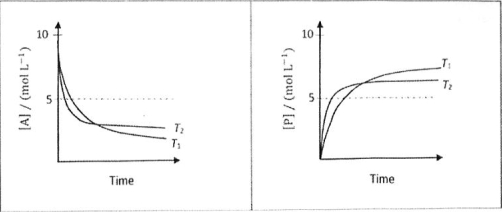
| Element | $IE_1$ | $IE_2$ | $IE_3$ |
| $P$ | $495.8$ | $4562$ | $6910$ |
| $Q$ | $737.7$ | $1451$ | $7733$ |
| $R$ | $577.5$ | $1817$ | $2745$ |
Then incorrect option is