MCQ
Bonds present in $N_2O_5$ (nitrogen pentaoxide) are
- Aonly ionic
- Bonly covalent
- ✓covalent and co-ordinate
- Dcovalent and ionic
The structure of $N _2 O _5$ is given above.
There are both covalent and coordinate covalent bonds.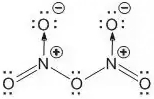
Generate a complete, print-ready paper with questions like this in minutes — across 16+ boards, with answer keys.
$C (diamond) + O_2 \rightarrow CO_2(g)\ ;\Delta H =\ -97.6\ kcal$
$C (graphite) + O_2 \rightarrow CO_2(g)\ ;\Delta H =\ -94.3\ kcal$
The heat change for the conversion of $1\ g$ of $C (diamond) \rightarrow C (graphite)$ is
$(A)$Covalent radius decreases down the group from $\mathrm{C}$ to $\mathrm{Pb}$ in a regular manner.
$(B)$ Electronegativity decreases from $\mathrm{C}$ to $\mathrm{Pb}$ down the group gradually.
$(C)$ Maximum covalence of $\mathrm{C}$ is $4$ whereas other elements can expand their covalence due to presence of $d$ orbitals.
$(D)$ Heavier elements do not form $\mathrm{p} \pi-p \pi$ bonds.
$(E)$ Carbon can exhibit negative oxidation states.
Choose the correct answer from the options given below:
$H _{2( g )}+ Br _{2( g )} \rightarrow 2 HBr _{( g )}$
Given that bond energy of $H _{2}$ and $Br _{2}$ is $435 \;kJ mol ^{-1}$ and $192 \;kJ mol^{-1}$, respectively, what is the bond energy (in $kJ mol ^{-1}$ ) of $HBr?$