MCQ
Boron rods in a nuclear reactor are used to:
  • A
    Absorb excess neutrons.
  • B
    Absorb alpha particle.
  • C
    Slow down the reaction.
  • D
    Speed up the reaction.

Answer

  1. Absorb excess neutrons.

Need a full question paper?

Generate a complete, print-ready paper with questions like this in minutes — across 16+ boards, with answer keys.

Start Generating Free

Similar questions

A achromatic combination is made with a lens of focal length f and dispersive power ω with a lens having dispersive power of 2ω. The focal length of second will be

(a) 2f

(b) f/2

(c) -f/2

(d) – 2 f

An electric dipole is placed in a uniform electric field. The net electric force on the dipole.
  1. Is always zero.
  2. Depends on the orientation of the dipole.
  3. Can never be zero.
  4. Depends on the strength of the dipole.
A direct current of 4 A is flowing through any circuit. Root mean square value of the current is:
The electrostatic potential due to an electric dipole is directly proportional to:
An alternating voltage$\text{V}=200\sqrt{2}\sin100\text{t},$ Where V is in volt and t is in seconds, is connected to a series combination of $1\mu\text{F}$ capacitor and $10\text{k}\Omega$ resistor through an AC ammeter. The reading of the ammeter will be_____.
The conduction band and valency band of a good conductor are:

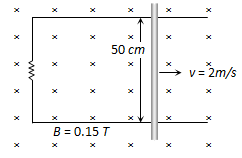
As shown in the figure a metal rod makes contact and complete the circuit. The circuit is perpendicular to the magnetic field with B = 0.15 tesla. If the resistance is 3Ω, force needed to move the rod as indicated with a constant speed of 2m/sec  is
(a) 3.75  N

(b) 3.75  

(c) 3.75  

(d) 3.75 

The two bulbs as in the above question are connected in series to a 200 volt line. Then

(a) The potential drop across the two bulbs is the same

(b) The potential drop across the 40 watt bulb is greater than the potential drop across the 100 watt bulb

(c) The potential drop across the 100 W bulb is greater than the potential drop across the 40 W bulb

(d) The potential drop across both the bulb is 200 volt

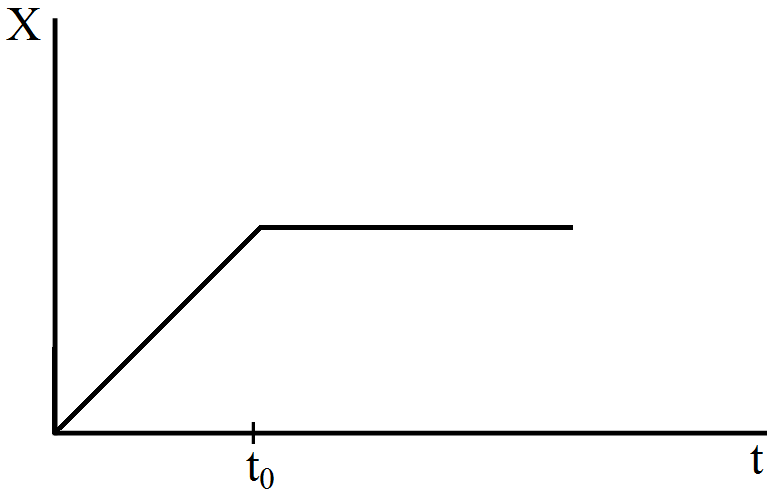
Figure shows the displacement-time graph of a particle moving on the X-axis.

  1. The particle is continuously going in positive x direction.
  2. The particle is at rest.
  3. The velocity increases up to a time to, and then becomes constant.
  4. The particle moves at a constant velocity up to a time to, and then stops.
To reduce the reasonant frequency in an LCR series circuit with a generator: