Question
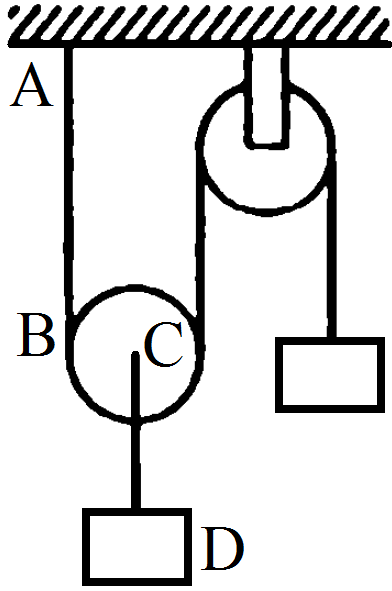
Both the strings, shown in figure are made of same material and have same cross-section. The pulleys are light. The wave speed of a transverse wave in the string AB is $\nu_1$ and in CD it is $\nu_2.$ Then $\frac{\nu_1}{\nu_2}$ is:

  1. $1$

  2. $2$

  3. $\sqrt{2}$

  4. $\frac{1}{\sqrt{2}}.$

Answer

  1. $\frac{1}{\sqrt{2}}$

Explanation:

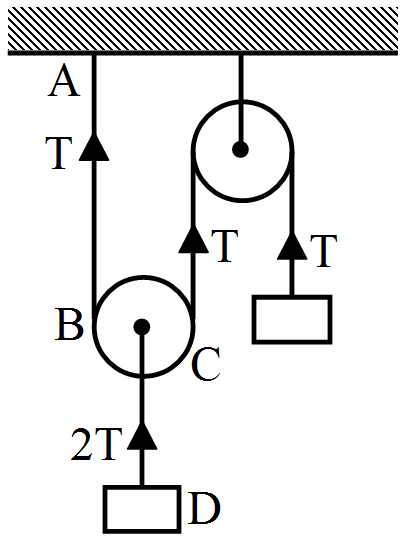
TAB = T

TCD = 2T

where

TAB is the tension in the string AB

TCD is the tension in the stnng CD

The eelatlon between tension and the wave speed is given by

$\text{v}=\sqrt{\frac{\text{T}}{\mu}}$

$\text{v}\propto\sqrt{\text{T}}$

where

v is the wave speed of the transverse wave

$\mu$ is the mass per unit length of the string

$\frac{\text{v}_1}{\text{v}_2}=\sqrt{\frac{\text{T}}{2\text{T}}}$

$=\frac{1}{\sqrt{2}}$

Need a full question paper?

Generate a complete, print-ready paper with questions like this in minutes — across 16+ boards, with answer keys.

Start Generating Free

Similar questions

Two bulbs of equal wattage, one having carbon filament and the other having a tungsten filament are connected in series to the mains, then

(a) Both bulbs glow equally

(b) Carbon filament bulb glows more

(c) Tungsten filament bulbs glows more

(d) Carbon filament bulb glows less

Mark out the correct options.
  1. The energy of any small part of a string remains constant in a travelling wave.
  2. The energy of any small part of a string remains constant in a standing wave. 
  3. The energies of all the small parts of equal length are equal in a travelling wave.
  4. The energies of all the small parts of equal length are equal in a standing wave.
Same current is flowing through two identical coils. Their centers are common and their planes are mutually perpendicular. Magnetic field at the center due to one coil is B then the resultant magnetic field at the common center is :
A heavy ring of mass m is clamped on the periphery of al light circular disc. A small particle having equal mass is clamped at the centre of the disc. The system is rotated in such a way that the centre moves in a circle of radius r with a uniform speed v. We conclude that an external force:

  1. $\frac{\text{mv}^2}{\text{r}}$ must be acting on the central particle.

  2. $\frac{2\text{mv}^2}{\text{r}}$ must be acting on the central particle.

  3. $\frac{2\text{mv}^2}{\text{r}}$ must be acting on the system.

  4. $\frac{2\text{mv}^2}{\text{r}}$ must be acting on the ring.

A set of atoms in an excited state decay.
In an intrinsic semiconductor, if Ne​ is the number of electrons in the conduction band and Np​ is the number of holes in the valence band then.
Chadwick was awarded the 1935 nobel prize in physics for his discovery of the:

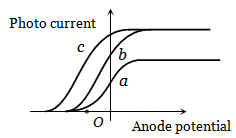
The figure shows the variation of photocurrent with anode potential for a photo-sensitive surface for three different radiations. Let   and  be the intensities and    and   be the frequencies for the curves a, b and c respectively

(a)  and  

(b)  and   

(c)  and  

(d)  and   

Suppose, the electron in a hydrogen atom makes transition from n = 3 to n = 2 in 10-8s. The order of the torque acting on the electron in this period, using the relation between torque and angular momentum as discussed in the chapter on rotational mechanics is:
  1. 10-34Nm
  2. 10-24Nm
  3. 10-42Nm
  4. 10-8Nm

Two charge + q  and  -q  are situated at a certain distance.  At the point exactly midway between them

(a) Electric field and potential both are zero

(b) Electric field is zero but potential is not zero

(c) Electric field is not zero but potential is zero

(d) Neither electric field nor potential is zero