-
$1$
-
$2$
-
$\sqrt{2}$
-
$\frac{1}{\sqrt{2}}.$
$1$
$2$
$\sqrt{2}$
$\frac{1}{\sqrt{2}}.$

$\frac{1}{\sqrt{2}}$
Explanation:

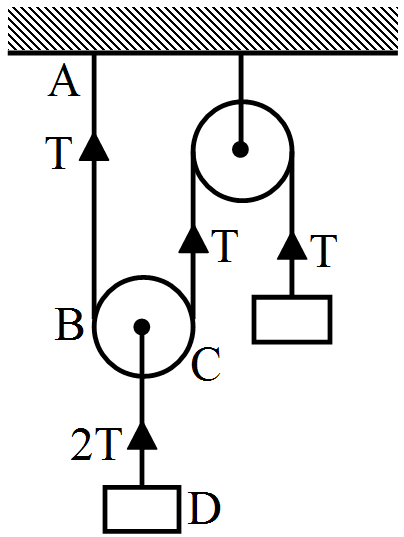
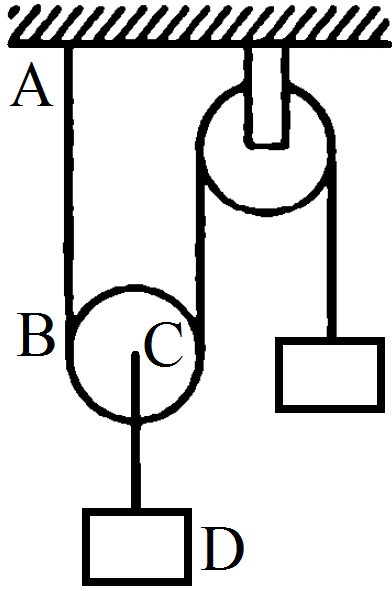
TAB = T
TCD = 2T
where
TAB is the tension in the string AB
TCD is the tension in the stnng CD
The eelatlon between tension and the wave speed is given by
$\text{v}=\sqrt{\frac{\text{T}}{\mu}}$
$\text{v}\propto\sqrt{\text{T}}$
where
v is the wave speed of the transverse wave
$\mu$ is the mass per unit length of the string
$\frac{\text{v}_1}{\text{v}_2}=\sqrt{\frac{\text{T}}{2\text{T}}}$
$=\frac{1}{\sqrt{2}}$
Generate a complete, print-ready paper with questions like this in minutes — across 16+ boards, with answer keys.
When a light wave goes from air into water, the quality that remains unchanged is its
|
(a) Speed |
(b) Amplitude |
(c) Frequency |
(d) Wavelength |
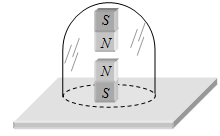
Two identical bar magnets with a length 10 cm and weight 50 gm-weight are arranged freely with their like poles facing in a inverted vertical glass tube. The upper magnet hangs in the air above the lower one so that the distance between the nearest pole of the magnet is 3mm. Pole strength of the poles of each magnet will be

|
(a) 6.64 amp × m |
(b) 2 amp × m |
(c) 10.25 amp × m |
(d) None of these |
An electron has mass 9
and charge 1.6
is moving with a velocity of
, enters a region where magnetic field exists. If it describes a circle of radius 0.10 m, the intensity of magnetic field must be
|
(a) 1.8 |
(b) 5.6 |
(c) 14.4 |
(d) 1.3 |